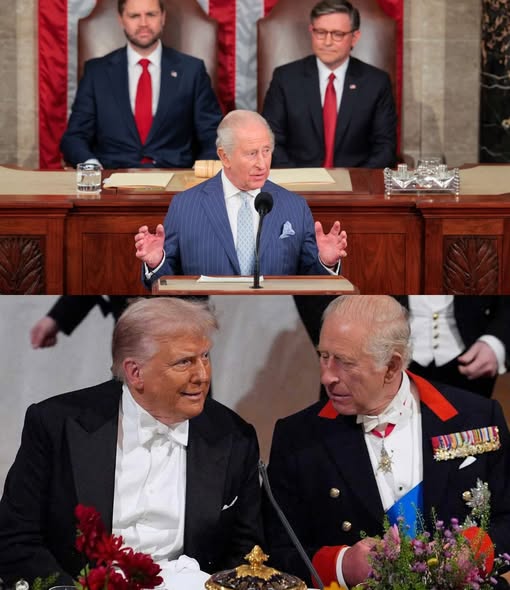
In a moment that has sent shockwaves through American politics, King Charles III addressed a joint session of Congress on Tuesday, delivering a speech that many are calling a “quiet demolition” of current U.S. leadership and its core principles. Standing at a podium installed by an act of Congress, the British monarch—who, by title, is a king in a constitutional monarchy—took the unprecedented step of publicly reaffirming the importance of checks and balances, religious pluralism, and the NATO alliance, even as the current U.S. administration appears to be unraveling many of these foundational pillars.
The King’s speech was rich with historical references, notably citing the Magna Carta and over 160 Supreme Court cases invoking it since 1789. His words rang with a pointed reminder: “not least as the foundation of the principle that executive power is subject to checks and balances.” Democrats responded immediately, rising to applaud, while Republicans hesitated before joining in, illustrating the growing political divide in the U.S.
Throughout his address, Charles subtly addressed the current political climate, most notably avoiding direct mention of President Trump but alluding to themes of executive overreach and the importance of institutions. His comments resonated with an overall tone reminiscent of the constitutional values the American Revolution fought so fiercely to establish—values seemingly under threat by the current administration.
He also spoke about Christianity, framing it not as a weapon but as “a firm anchor and daily inspiration,” emphasizing the role of faith and interfaith dialogue in cultivating understanding among diverse communities. This stance starkly contrasts with the administration’s recent rejection of religious pluralism, illustrating the King’s desire to promote unity and respect across faiths.
Further, the King addressed NATO, referencing the alliance’s pivotal role in global security, especially after the Cold War era and the recent conflicts in Afghanistan and Ukraine. “In the immediate aftermath of 9/11, when NATO invoked Article 5 for the first time, and the United Nations Security Council was united in the face of terror, we answered the call together, as our people have done so for more than a century,” he stated. His plea was clear: “Today, that same unyielding resolve is needed for the defense of Ukraine and her most courageous people.”
This call to action was especially poignant given the current U.S. administration’s approach to Ukraine—a stark contrast to the unity and resolve he championed. President Trump, who accused Ukraine of “gambling with World War III,” has cut military aid and downplayed the importance of NATO’s collective security, raising questions about America’s commitment to its allies.
It is a remarkable irony—two centuries ago, Americans fought to free themselves from British rule. Now, a British king stands before the U.S. Congress, emphasizing the principles of limited power, religious tolerance, and international cooperation. Meanwhile, the sitting American president appears to be working to undermine these very ideals.
The speech has ignited debate across political lines: is this a symbolic gesture, or a pointed reminder of the foundational values that all democracies must uphold? Either way, the moment underscores a profound truth—that even a monarch, in an age of tumult, can serve as a voice for the principles that sustain liberty and justice around the world.
Where to Learn More
- King Charles Addresses U.S. Congress, Urges Limits on Power – The New York Times
- Royal Address Highlights Clash of Values in American Politics – The Washington Post
- King Charles’ Historic Speech in the U.S. Capitol – BBC News
- Analysis of King Charles’ Remarks on Democracy and International Alliances – CNN