
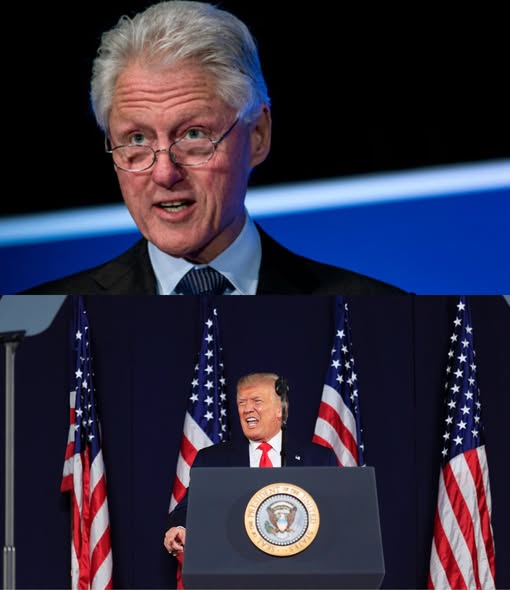
As the nation celebrated its 250th birthday at Mount Rushmore, President Donald Trump delivered a fiery speech warning of “a resurgence of the communist menace” threatening American values. Standing before the iconic monument, he lamented what he called the dangerous rise of communism and socialism, framing it as a threat to the country’s future. But within hours, a sharp rebuttal arrived from an unlikely source: former President Bill Clinton.
In stark contrast to Trump’s patriotic rhetoric, Clinton, now 79 and reflecting on decades of politics, issued a pointed critique of the state of American governance. Unlike the more muted statements from other ex-presidents, Clinton’s statement was a clear, unapologetic indictment of systemic inequalities and government corruption. His words painted a picture of a country that, under current economic and political systems, offers *socialism* not just to the impoverished but — as he put it — “for the super-rich.”
Clinton’s critique highlighted a landscape dominated by government actions that favor the wealthy. He pointed to the increasingly aggressive enforcement of laws that target citizens instead of protecting them, including “masked agents seizing people from their homes, workplaces, and streets,” a reference to recent law enforcement protests. He denounced the reckless commencement of wars, like the latest escalation against Iran, launched without clear objectives or exit strategies. And he took aim at the Supreme Court and Congress for being staffed with lifetime loyalists and compliant legislators, routinely used to prosecute political enemies and suppress free speech.
“Their New Deal is socialism for the super-rich,” Clinton declared, framing today’s economic policies as a transfer of wealth upward rather than a redistribution for everyone. This statement echoes the language of the civil rights leader Martin Luther King Jr., who in the 1960s lamented that the country practiced “socialism for the rich and rugged individualism for the poor.”
The former President emphasized that his critique was not aimed directly at Trump but at “the people in charge,” suggesting that the current political and economic elite have fundamentally altered the American landscape for their own benefit. Notably, Clinton didn’t flatly oppose the policies Trump supports—his comments focused on the systemic inequalities that have deepened over the decades.
Interestingly, just a day before Clinton’s statement, Trump had spoken warmly about his predecessor, praising him in a lighthearted moment on a children’s book podcast, saying, “He actually was a nice guy. I like Bill Clinton a lot. I still do.” But Clinton’s response made it clear that their political paths remain sharply divided, with the former president choosing to focus on what he perceives as the core issues plaguing the nation—wealth inequality, unchecked government power, and the erosion of democratic norms.
The exchange underscores the deep ideological divides in American politics, with Trump warning of external threats like communism and Clinton pushing a narrative of internal systemic corruption benefiting an elite few. As the country approaches another election cycle, these contrasting visions of America’s identity and future promise to remain at the heart of political debate.
Where to Learn More
- Trump Warns of Communist Menace at Mount Rushmore on Independence Day – The New York Times
- Bill Clinton Blasts ‘Socialism for the Super-Rich,’ Calls Out Inequality – The Washington Post
- Clinton’s Response to Trump’s Independence Day Speech – NPR
- Analysis: Clinton Frames U.S. Economy as ‘Socialism for the Super-Rich’ – CNN