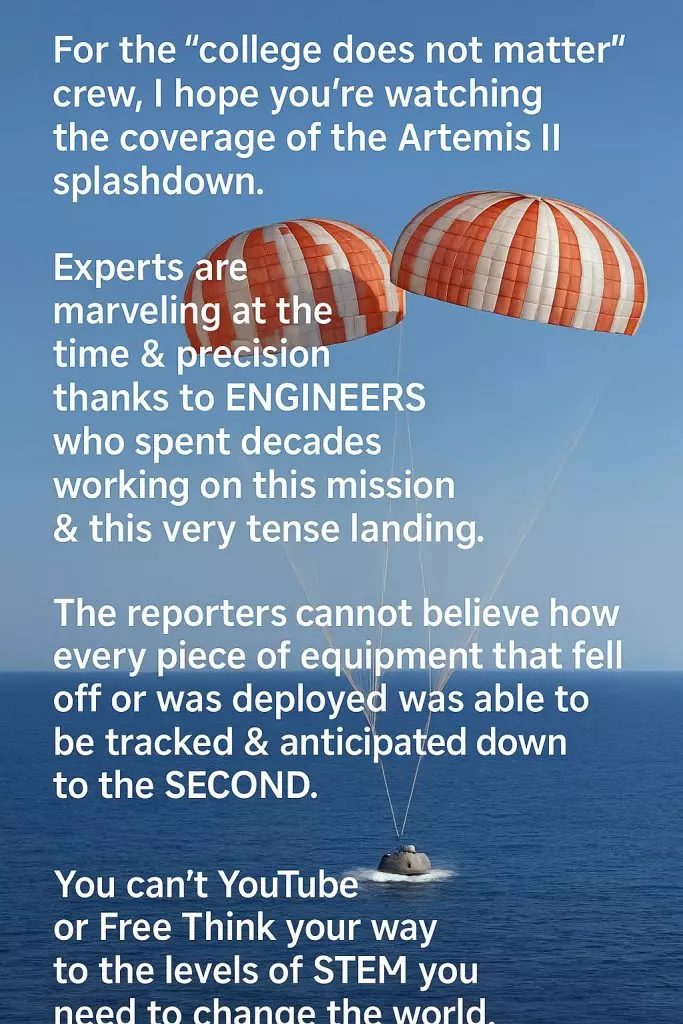
For those who believe a college education is optional or irrelevant, the recent Artemis I spacecraft splashdown serves as a compelling reminder of the extraordinary value of skilled knowledge and rigorous training. As global audiences tuned in to watch the triumphant return of NASA’s uncrewed Orion capsule, experts around the world praised the mission’s impeccable timing, precision, and complexity—achievements that rest solidly on decades of specialized education and collaboration.
The Artemis I mission, a crucial step toward NASA’s goal of returning humans to the Moon and beyond, culminated with Orion’s splashdown in the Pacific Ocean. The event demonstrated the incredible orchestration required in aerospace science, engineering, and mission operations. Every second was meticulously calculated—from re-entry trajectory to the pinpoint accuracy of the spacecraft’s landing zone.
“This is a textbook example of how expertise, built through extensive education and experience, directly translates into real-world success,” noted aerospace analyst Dr. Camille Perez. “The Artemis splashdown underscores how vital a comprehensive understanding of physics, engineering, and calculation is for space missions. This is not guesswork; it’s precision perfected over years of study and practice.”
What makes the Artemis I splashdown particularly impressive is the scale of coordination involved. NASA teams worked tirelessly to ensure the spacecraft re-entered Earth’s atmosphere safely at speeds exceeding 25,000 miles per hour. From mission controllers plotting the spacecraft’s course, to engineers testing heat-shield materials that endure extreme temperatures, the entire process hinged on accumulated expert knowledge made possible by advanced education and ongoing training programs.
This achievement also highlights the broader societal benefits of investing in scientific education and exploration. Beyond inspiring future generations, Artemis I’s success opens new pathways for technological innovation with potential applications in various fields including materials science, telecommunications, and environmental monitoring.
Moreover, the mission’s high-stakes nature reveals why relying solely on natural talent or informal training would simply not suffice. The layers of complexity demand extensive collaboration among scientists, engineers, and mathematicians—many of whom have spent years cultivating their skills in college and graduate programs.
The Artemis splashdown is more than just a spectacular endpoint to a historic mission; it’s a testament to how education empowers these remarkable feats. As social media buzzes with excitement and awe, it’s worth reflecting on the undeniable fact that knowledgeable, trained minds made this milestone possible. For those skeptical of traditional education paths, the precise artistry and science of Artemis I might just change their minds.
NASA’s Artemis I mission stands as a shining example of why valuing education and expertise is essential—not only to reach the stars but to push the boundaries of human potential.
Where to Learn More
- Artemis I Splashdown – NASA
- NASA Artemis I Moon Mission Overview – Space.com
- The Art and Science of Spacecraft Re-entry – Scientific American
- Watch Timely Artemis I Orion Capsule Splashdown – NBC News