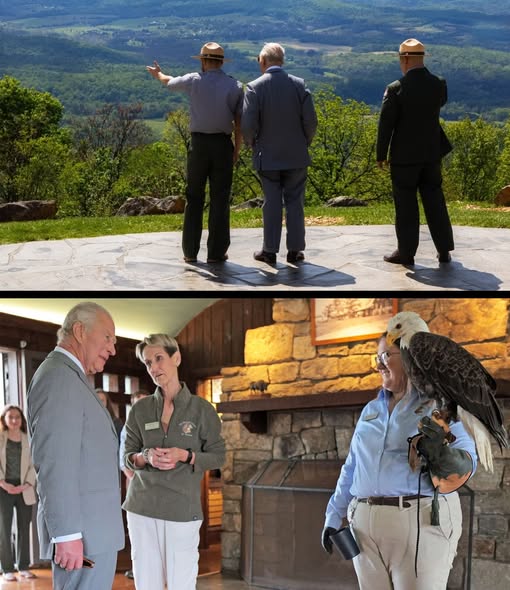
In a world often fixated on grand gestures and headlines, King Charles III quietly demonstrated a moment of genuine environmental warmth during his recent state visit to the United States — and it went largely unnoticed by the mainstream media. The monarch, known for his lifelong dedication to conservation, spent his final day in Virginia visiting Shenandoah National Park. There, he engaged with park rangers, swore in new Junior Rangers, met with Buddy the bald eagle, and unveiled stones commemorating a groundbreaking new conservation partnership between Shenandoah and the Cairngorms National Park in Scotland.
This sequence of actions might seem routine for a visitor, but for Charles, it symbolized decades of unwavering commitment to protecting the natural world. Since converting his own estate to organic farming in 1986 — a move mocked by the British press at the time for caring too loudly about ecological issues — the King has consistently placed environmental stewardship at the forefront of his life’s work. His presence at Shenandoah, engaging with local conservation efforts with warmth and curiosity, was a quiet but powerful reminder that genuine care for nature need not be loud to be impactful.
What makes this moment particularly striking is its silence in the news cycle. While the King’s actions received little media hype, it underscores an uncomfortable truth about the current state of leadership concerning America’s public lands. In stark contrast, the United States has seen its national parks and forests suffer under policies that favor commercial exploitation over preservation.
Since taking office, former President Donald Trump notably decentralized federal protections, rolling back critical regulations like the Roadless Rule and opening millions of acres of national forests to logging, mining, and development. This corporate-led push has transformed vast swaths of cherished landscapes into commodities rather than protected treasures. Recent reports indicate the administration has even aimed to sell or lease hundreds of thousands of acres of federal land to private interests, stripping Americans of their right to enjoy and preserve these natural spaces.
By comparison, King Charles’ visit and her actions serve as a stark reminder of what true leadership on environmental issues looks like — genuine curiosity, respect, and a personal connection to the natural world. It is telling that a foreign monarch, whose core mission has long been conservation, showed more visible respect for America’s public lands in a day than the sitting U.S. president has in years.
As social media lit up with praise for the King’s authentic gestures, it also legalizes a broader conversation: why isn’t the United States doing more to prioritize conservation? When a foreign head of state laps up the beauty of North American wilderness with warmth and sincerity, it makes one wonder — why isn’t this felt and celebrated at home?
Our public lands are among America’s most valuable resources, not just for their beauty, but for their ecological importance and the legacy they leave future generations. It is time for national leaders to step up and match the quiet, steadfast dedication demonstrated by King Charles III — before it’s too late.
Where to Learn More
- How Trump’s Policies Impacted America’s Public Lands – The New York Times
- Protecting Our National Parks: The Need for Strong Federal Policies – National Parks Travels
- The Global Conservation Movement and How Leadership Matters – Conservation International
- King Charles III’s Surprise Visit to US National Park Highlights Conservation Passion – The Independent