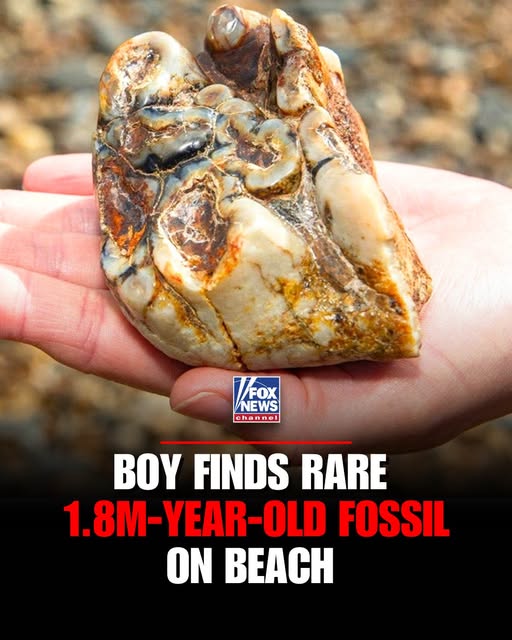
What began as an ordinary day spent exploring the shoreline in Suffolk, England, turned into an extraordinary archaeological discovery for 11-year-old Charlie Orchard-Lisle. While combing through the sands along the coastline, the young explorer spotted a curious object partially buried in the pebbles. To his amazement, he uncovered a **rare 1.8 million-year-old fossil**, believed to be the upper left molar of a prehistoric elephant species that once roamed the region.
The fossil, approximately 4 inches wide, immediately caught Charlie’s attention due to its unique texture and size. Recognizing it might be something unusual, he alerted his family, who promptly contacted local experts and paleontologists for identification.
Scientists from the Museum of Archaeology and Paleontology in nearby Ipswich quickly examined the relic. After a thorough analysis, paleontologists confirmed the find as an **ancient elephant tooth dating back approximately 1.8 million years**, during the mid-Pleistocene epoch. The fossil is believed to belong to a species akin to the extinct *Mammuthus meridionalis* or a related prehistoric proboscidean, which once roamed parts of Europe.
“Discoveries like this are exceedingly rare, especially from such a young and enthusiastic amateur,” said Dr. Amelia Roberts, a paleontologist involved in the analysis. “This fossil provides valuable insight into the prehistoric fauna of the region, indicating that elephants or their ancestors once inhabited this area millions of years ago.”
The discovery has sparked excitement among scientists and local residents alike, highlighting the importance of citizen science and exploration. It also underscores the treasure trove of fossils that can still be hidden beneath our feet, waiting to be uncovered by unexpected heroes like Charlie.
As for Charlie, his discovery has earned him local and national recognition, and he’s been praised for his keen eye and curiosity. The fossil will be carefully preserved and added to the museum’s collection, offering a tangible link to Earth’s ancient past for future generations to study and admire.
This remarkable event not only sheds light on the prehistoric ecology of Suffolk but also inspires young explorers to engage with science and history. Who knows—perhaps the next groundbreaking fossil discovery could be just a beach walk away.
Where to Learn More
- Suffolk boy discovers 1.8 million-year-old elephant fossil – BBC News
- Ancient Elephant Tooth Discovered in Suffolk – Natural History Museum
- Young Boy Finds Rare Prehistoric Fossil on Suffolk Beach – Heritage Heritage.com