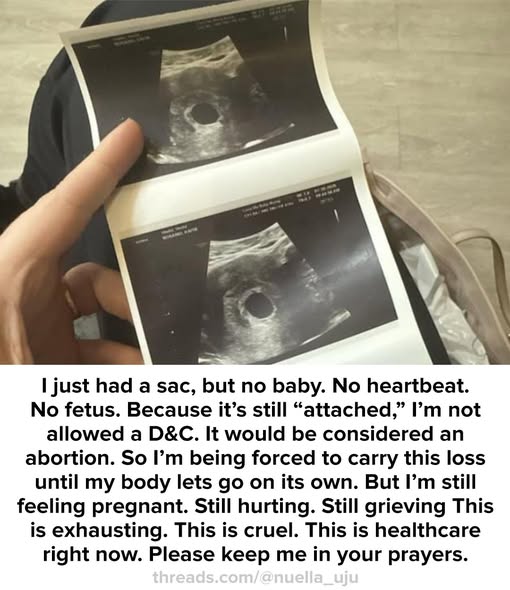
A woman recently shared her deeply personal and painful experience on social media, shedding light on a complex and emotionally charged issue surrounding reproductive health laws. Her story has quickly gone viral, sparking widespread debate about medical autonomy, legal restrictions, and women’s rights during pregnancy complications.
The woman described how she experienced a miscarriage, often referred to as a “spontaneous abortion” in medical terms, where her pregnancy tissue had been naturally expelled but the fetus had no heartbeat or viable fetus remaining. Despite her body passing the pregnancy tissue, she faced an agonizing legal barrier: because her uterus was still “attached,” she was prohibited from undergoing a D&C (dilation and curettage) procedure, which is typically used to remove remnants of pregnancy tissue after a miscarriage.
According to her account, healthcare providers informed her that removing the remaining tissue would be classified legally as an abortion, which under current laws in some regions is heavily restricted or outright banned after a certain point. This meant she was forced to carry the nonviable tissue within her, enduring ongoing pain and emotional distress, without the ability to have the procedure that would relieve her suffering.
Her social media post included an image with words expressing her frustration: “SAAS just had a sac, but no baby. No heartbeat. No fetus. Because it’s still attached, I’m not allowed a D&C. It would be considered an abortion. So I’m being forced…” The starkness of her message underscores the emotional toll and the ongoing legal debates about reproductive rights and healthcare autonomy.
This story echoes broader national conversations about the impact of restrictive abortion laws on women experiencing pregnancy loss. Critics argue that laws conflating miscarriage management with abortion restrictions can prevent timely and necessary medical care, leading to physical and psychological suffering.
Legal experts and healthcare professionals have voiced concern that such restrictions undermine women’s health and autonomy. The American College of Obstetricians and Gynecologists (ACOG) emphasizes that ensuring timely medical intervention is crucial during miscarriages, and laws that ambiguously restrict post-miscarriage procedures threaten to complicate this care.
Other advocates point out that the legal classification of pregnancy tissue retention as an ongoing pregnancy or even an abortion can have dangerous implications, especially for women facing pregnancy loss in states with strict anti-abortion legislation.
This case highlights a need for clearer guidelines and compassionate medical policies that prioritize women’s health over legal definitions. It also underscores the importance of public awareness and advocacy in shaping health laws that respect both legal and medical standards.
As this story continues to unfold, it serves as a stark reminder of the ongoing struggles women face in navigating reproductive healthcare within a polarized legal landscape. Many are calling for reform that ensures women are not trapped between legal constraints and their health needs.
Where to Learn More
- American College of Obstetricians and Gynecologists (ACOG) – Guidelines on miscarriage management and legal implications
- NPR: How Legislation Affects Women During Pregnancy Loss
- Planned Parenthood: Reproductive Rights and Laws
- Vox: The Impact of Abortion Restrictions on Miscarriage Care