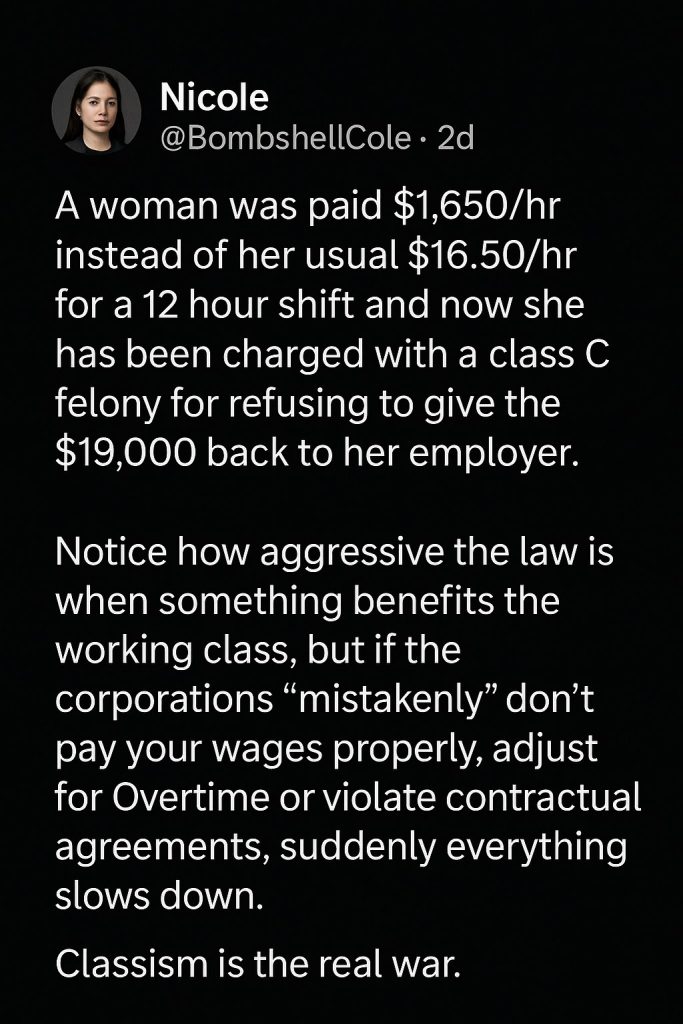
An extraordinary payroll error has sparked a legal controversy after a woman was mistakenly paid $1,650 for a 12-hour shift — instead of her usual $16.50 per hour rate — and subsequently charged with a class C felony when she refused to return the overpayment.
The incident began when Nicole, identified on social media by the handle @BombshellCole, received an astonishing paycheck nearly 100 times greater than her regular wage. Nicole’s typical hourly rate is $16.50, so for a 12-hour shift she would expect to earn approximately $198. Instead, her bank account was credited with $1,650, a massive error that understandably caught her attention.
Instead of alerting her employer or returning the funds, Nicole reportedly kept the money. This decision has now led to serious legal consequences. Authorities have charged her with a class C felony — an offense that often involves punishments such as significant fines and possible jail time, depending on jurisdiction.
The case has sparked a heated debate across social media platforms and legal circles. Some argue that Nicole should have no obligation to return money she did not earn, particularly if the employer did not notice the mistake beforehand. Others contend that keeping the money constitutes theft or fraud, and that ethical and legal standards require repayment.
According to experts, payroll mistakes can legally be classified as unjust enrichment, meaning one person benefits at another’s expense in a manner deemed unfair by the law. Employers generally have the right to reclaim mistaken payments, and when recipients refuse, it can escalate to criminal charges.
The legal ramifications for Nicole hinge on whether prosecutors can prove that she knowingly intended to defraud her employer by retaining funds she was not entitled to. Given the stark discrepancy between the typical pay and the erroneous amount, the charge of a class C felony suggests authorities view this as a significant offense.
Ethical considerations and employee rights often complicate cases like this. Many experts advise employees who notice overpayments to immediately notify their payroll department to avoid potential lawsuits or criminal charges. Similarly, companies are reminded to act swiftly to correct payroll errors, communicating clearly and documenting all steps.
This story has ignited conversations about fairness, legal responsibility, and the consequences of an honest or intentional mistake. It serves as a cautionary tale for both employees and employers regarding payroll accuracy and ethical conduct in financial transactions.
As Nicole’s case moves forward, it will likely prompt legal discussions about the treatment of payroll errors and employee obligations in the digital age where instant payments and automated systems predominate.
What happens next remains to be seen, but the message to workers everywhere is clear: if paid too much, it is best to report the error — or risk facing serious consequences.
Where to Learn More
- Wrongful Paycheck Overpayment: How Employers Can Recover Wages – Nolo
- Payroll Mistakes and Your Rights – FindLaw
- What To Do If You Receive Too Much Pay – The Balance Careers
- Unjust Enrichment – Cornell Law School Legal Information Institute