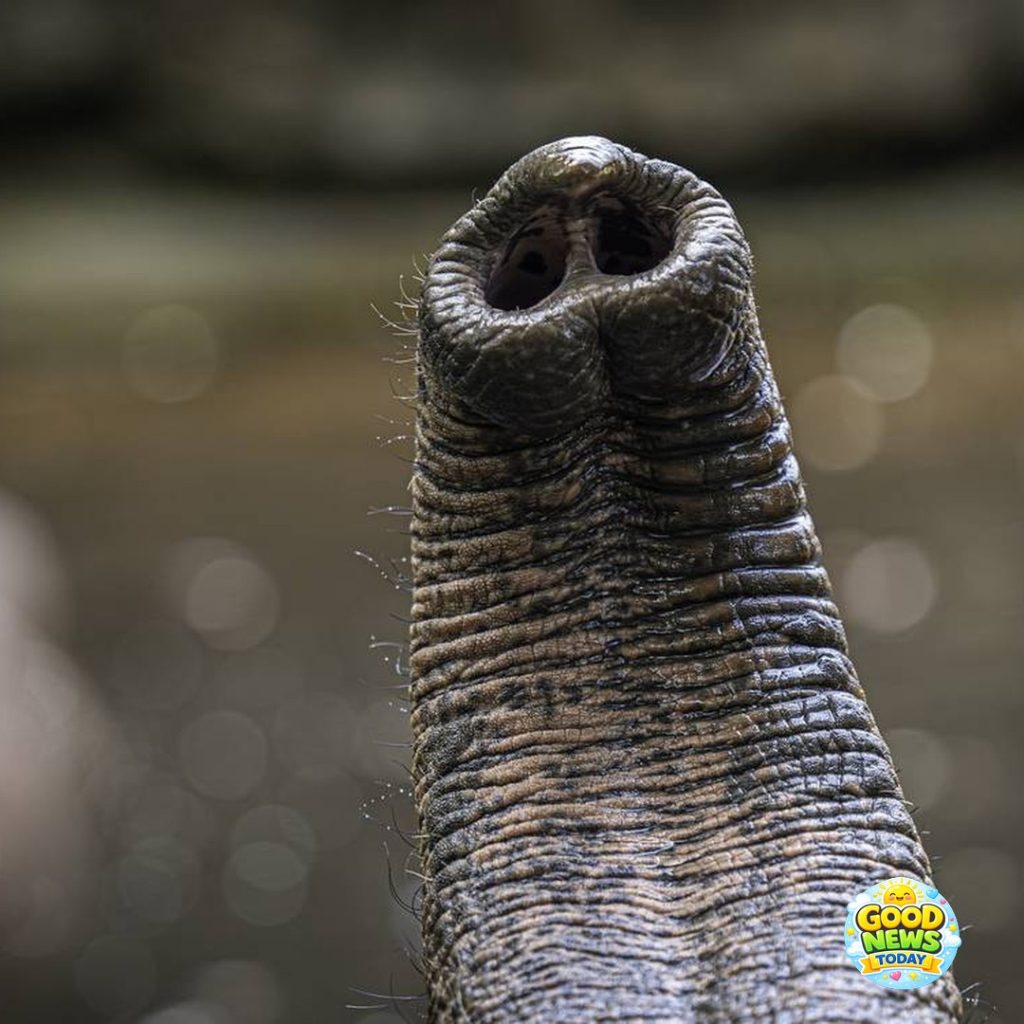
The remarkable whiskers found on an elephant’s trunk play a crucial role in its extraordinary sense of touch, according to recent research.
These 1,000 specialized hairs covering the trunk exhibit unique properties that allow the largest land animal to detect contact points along each whisker. This incredible ability enables elephants to pick up objects as small as a peanut, as noted by scientists.
Unlike the stiff, uniform whiskers of rats and mice, elephants and domestic cats possess whiskers that feature stiff bases transitioning to soft, rubber-like tips. This unique design is known as a functional gradient.
A research team from Germany believes that this stiffness gradient is pivotal for elephants, enabling them to precisely sense where contact occurs along each of their 1,000 trunk whiskers. This skill allows them to perform delicate tasks, such as picking up a tortilla chip without breaking it.
Inspired by the functional gradients of elephant and cat whiskers, the researchers are now exploring the creation of innovative robotic sensing technologies.
Dr. Andrew Schulz, the leader of the study, explained, “The stiffness gradient provides a map that allows elephants to detect where contact occurs along each whisker. This feature helps them gauge the distance of their trunk from an object, all intricately designed into the geometry, porosity, and stiffness of the whisker.”
“Engineers refer to this natural phenomenon as embodied intelligence, which is truly fascinating,” he added.
The research team meticulously examined the structure, porosity, and softness of elephant trunk whiskers. By utilizing micro-CT scanning, they were able to analyze the 3D shape of several whiskers. Their findings revealed that elephant whiskers are thick and blade-like, with a flattened cross-section, a hollow base, and numerous long internal channels, similar to the structure of sheep horns and horse hooves, but distinct from rat whiskers, which was their initial hypothesis.
The porous design of these whiskers reduces their mass and enhances impact resistance, allowing elephants to consume hundreds of kilograms of food daily without fear of damaging their whiskers, which do not regenerate.
Initially, the discovery of the stiffness gradient in elephant trunk whiskers puzzled the researchers, leaving them curious about its significance for touch sensing. To investigate further, Dr. Schulz collaborated with colleagues at the Max Planck Institute for Intelligent Systems (MPI-IS) in Stuttgart to 3D print a scaled-up version of a whisker, featuring a stiff, dark base and a soft, transparent tip.
This innovative “whisker wand” prototype provided the team with valuable insights into how an elephant’s trunk interacts with its surroundings through its whiskers.
After a meeting, Dr. Schulz entrusted the wand to his mentor, Professor Katherine Kuchenbecker, who took it with her as she walked through the Institute, playfully tapping it against various columns and railings.