
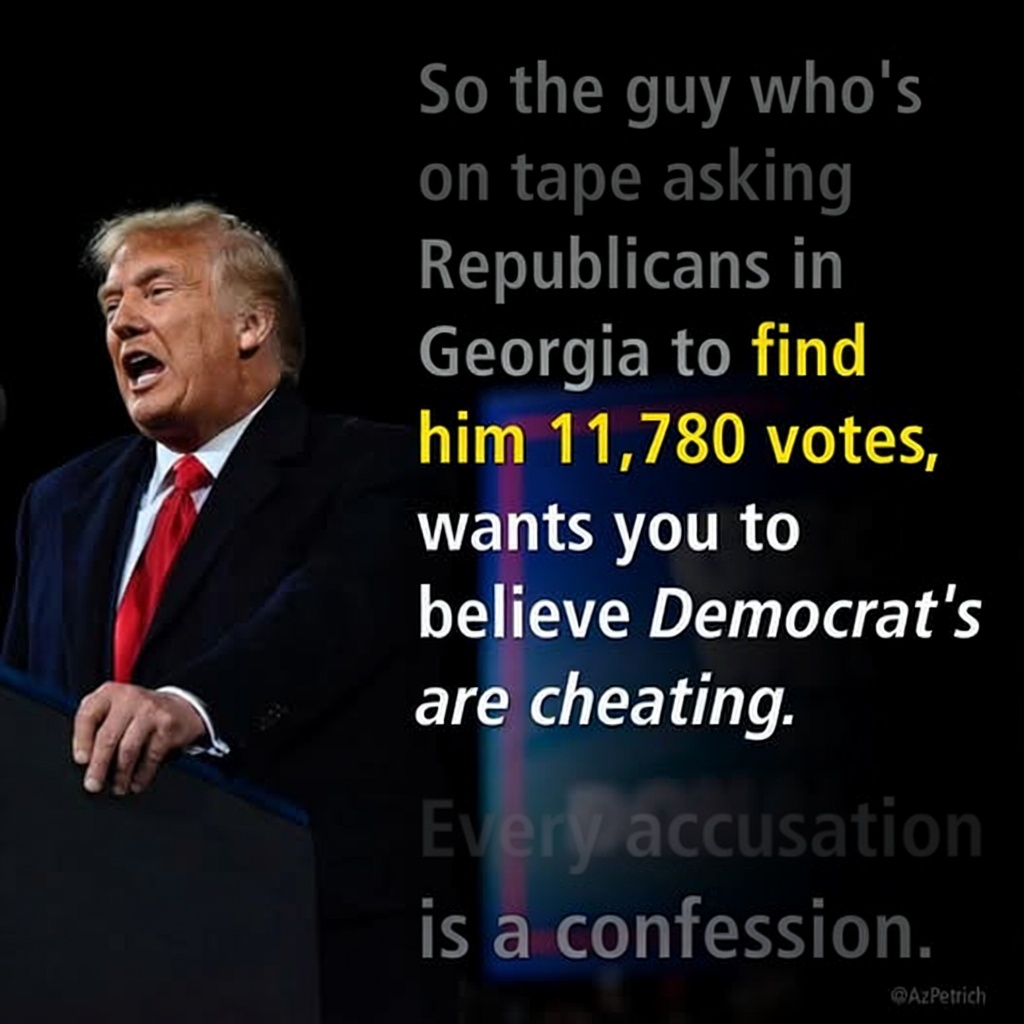
A recent social media meme has ignited debates across the political spectrum, highlighting a provocative statement: “So the guy who’s on tape asking Republicans in Georgia to find him 11,780 votes, wants you to believe Democrats are cheating. Every accusation is a confession.” This catchy phrase combines viral satire with sharp political critique, emphasizing a growing narrative that questions the integrity of recent election claims.
At the core of this viral meme is a reference to a recording where a prominent political figure, widely reported to be former President Donald Trump, urges Georgia officials to ‘find’ additional votes. The phrase “asking Republicans in Georgia to find him 11,780 votes” alludes to a widely circulated transcript of a phone call made in January 2021, where Trump and his allies pressed Georgia election officials to overturn President Biden’s victory in the state. Many critics interpret this call as an explicit attempt to influence the electoral process, while supporters dismiss it as a routine political conversation.
The meme’s author juxtaposes this recorded incident with the popular accusation that Democrats are engaging in widespread electoral cheating. Their argument is that by pointing fingers at alleged misconduct by the opposition, some are inadvertently exposing their own motives. The phrase “Every accusation is a confession” echoes a well-known saying, suggesting that allegations against opponents often reveal the true intentions or misconduct of the accusers themselves.
Political analysts note that this meme taps into broader discussions about accountability, transparency, and trust in the electoral process. Critics of current narratives argue that accusations about election fraud often distract from substantive policy debates and undermine democratic institutions. Conversely, supporters of election integrity emphasize the importance of scrutinizing electoral procedures, especially amid widespread claims of voting irregularities.
This viral social media post reflects a broader polarization in America’s political discourse—where frames of “conspiracy” and “truth” often blur. It serves as a reminder that political narratives are frequently crafted to influence public perception, with some leaders and movements framing their message as a battle between honesty and deception.
While the meme’s bold claim underscores feelings of distrust rooted in recent electoral events, many experts warn that interpreting political actions through simple dichotomies risks oversimplifying complex issues. Nonetheless, its virality demonstrates how digital platforms continue to serve as battlegrounds for ideological battles, shaping narratives with potent brevity and emotional appeal.