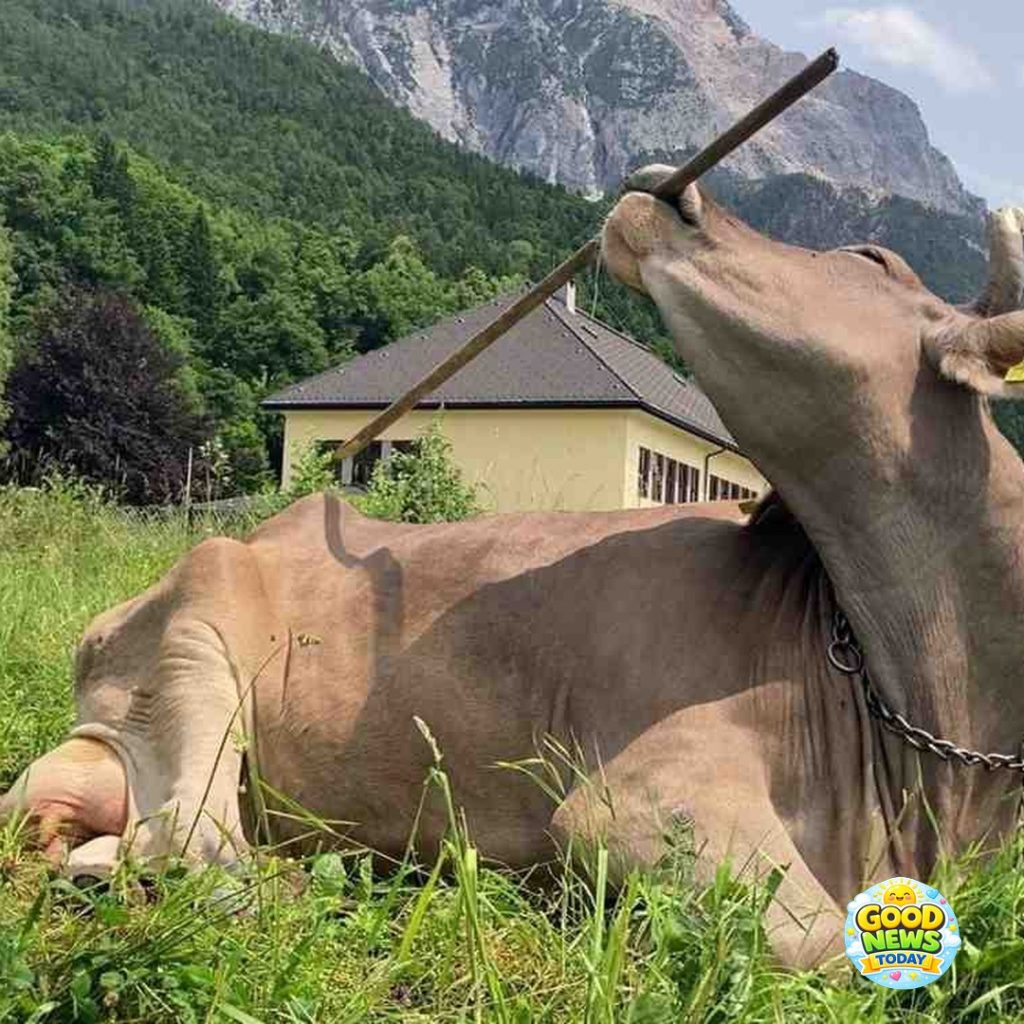
A remarkable cow named Veronika has made history as the first bovine recorded using tools—a brush or stick—to scratch her back.
This extraordinary Swiss Brown cow has left scientists in Austria astounded with her clever use of a broom, showcasing a rare ability that has only been convincingly documented in chimpanzees outside of humans.
Veronika is not raised for meat or milk; instead, she enjoys a loving life as a companion to organic farmer and baker Witgar Wiegele, who considers her a cherished member of his family. Over a decade ago, Wiegele observed Veronika occasionally picking up sticks to scratch herself, a behavior that piqued scientific interest.
The fascinating behavior gained attention when it was captured on video and shared with cognitive biologist Professor Alice Auersperg. Dr. Auersperg has conducted a groundbreaking study, published in the journal Current Biology, marking the first documentation of tool-use in a cow.
“These findings illuminate how our assumptions about livestock intelligence may stem from observation gaps rather than true cognitive limitations,” Dr. Auersperg shared. “Upon viewing the footage, it was clear this was not a random act; it was a meaningful demonstration of tool use in a species often overlooked for its cognitive abilities.”
To explore Veronika’s talent further, Auersperg and her colleague Dr. Antonio Osuna-Mascaró visited her to conduct a series of 70 systematic tests. During these controlled trials, they presented a deck brush on the ground in various orientations.
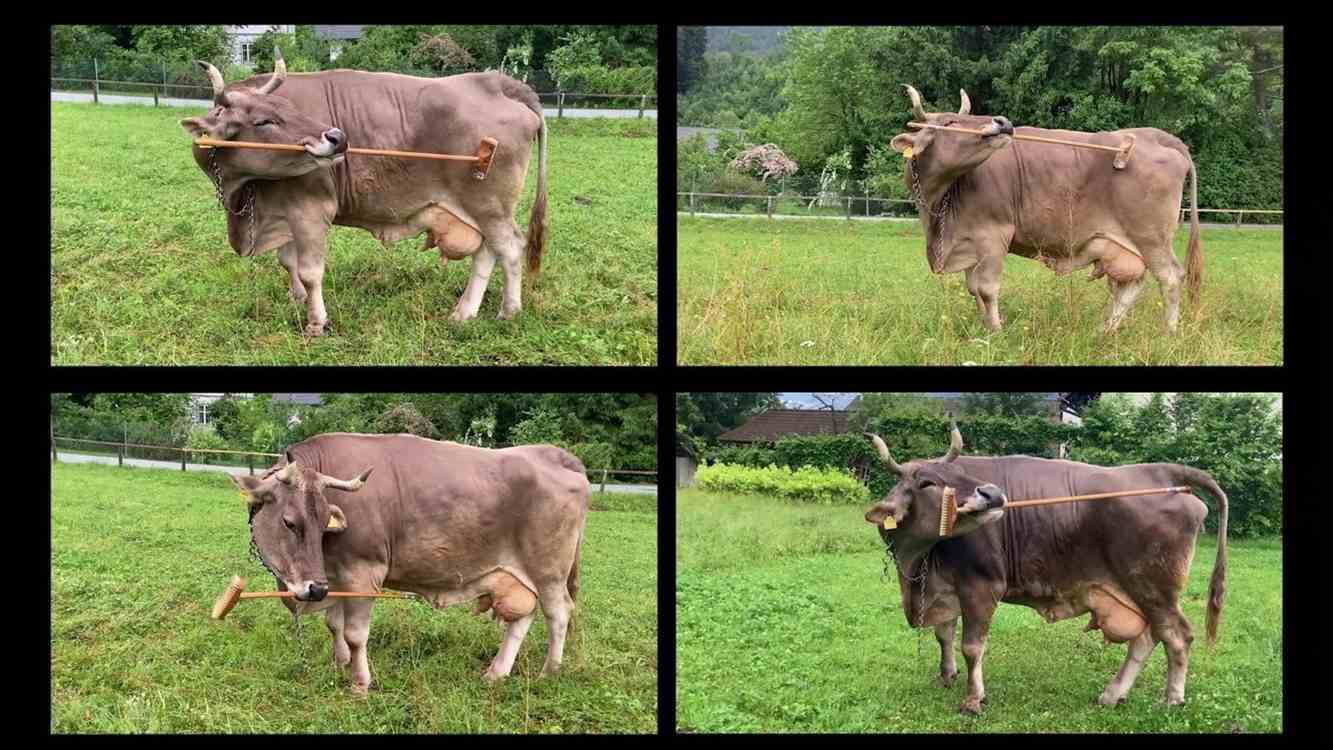
The researchers meticulously recorded which end Veronika chose and the specific body areas she targeted. Across multiple sessions, they discovered that her selections were “consistent and functionally appropriate” for the areas she was scratching.
“Veronika employs each part of the broom in unique ways,” noted Dr. Osuna-Mascaró. “She utilizes different techniques based on the function of the tool and the body region she is addressing.”
The study revealed that Veronika typically favors the bristled end of the deck brush for scratching broader, firmer areas like her back. However, when it comes to softer, more sensitive parts of her lower body, she deftly switches to the smooth stick end.
Not only does Veronika adjust her choice of tool end, but she also modifies her method of use depending on her goal. Scratching her upper body involves wide, vigorous movements, while her lower body scratching is characterized by slower, more meticulous, and controlled actions, occasionally involving precise taps.
Tool-use is defined as manipulating an external object to achieve a goal through mechanical means. The Austrian research team found that Veronika’s behavior not only fits this definition but also exemplifies flexible, multi-purpose tool use—employing various features of the same object to achieve different functional outcomes.
“Since she is using the tool on her own body, this represents an egocentric form of tool use, which is generally deemed less complex than tool use directed at external objects,” explained Dr. Osuna-Mascaró.