
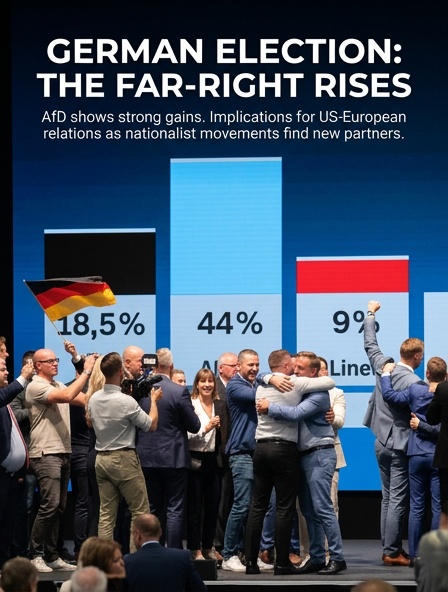
In a surprising turn of foreign policy perspective, the Trump administration appears to view Germany’s far-right party, the Alternative for Germany (AfD), as an ideological ally in the broader push to reshape Western politics. This alignment signals a potentially dangerous shift, as empowering the AfD risks amplifying a nationalist movement in Europe that could challenge longstanding alliances and weaken American influence globally.
Since taking office in January 2025, President Donald Trump has consistently championed a nationalist, America-first approach, often signaling admiration for movements that challenge the status quo. Recently, this approach has extended into Europe, where the administration views the AfD as a mirror image of their “MAGA” ideology—focused on sovereignty, skepticism of immigration, and opposition to the European Union’s traditional leadership.
The AfD, founded in 2013, has gained ground by capitalizing on frustrations over immigration policies, economic sovereignty, and perceived European Union overreach. While officially classified as a far-right party with controversial stances, the Trump administration reportedly sees potential in forging closer ties—seeing the AfD as a strategic partner to counterbalance more centrist or liberal forces within German politics and Europe at large.
However, experts warn that this alliance could produce unintended consequences. “Empowering the AfD risks emboldening a nationalist wave that seeks to reconfigure Europe on fundamentally anti-globalist grounds,” says Dr. Laura Becker, a European political analyst. “Such a movement not only threatens the EU’s unity but could also dramatically weaken transatlantic ties, especially if these nationalist forces adopt an anti-American stance or pursue policies that challenge U.S. global interests.”
Indeed, the AfD’s rhetoric often targets what they see as American overreach and dominance—aligning with Europe’s growing skepticism of U.S.-led globalization initiatives. Analysts fear that backing this movement could lead to a Europe more fragmented, less inclined to participate in NATO, and more receptive to alliances with Russia and other unfriendly powers—exactly the opposite of America’s strategic goals.
Policy experts suggest this move reflects a broader trend among populist movements worldwide: seeking to heighten divisions domestically and abroad in pursuit of national interests. While President Trump’s team views the AfD as a useful partner, critics argue that these alliances threaten to undermine decades of diplomatic cooperation and destabilize an already fragile European geopolitical landscape.
As Europe and the United States navigate this complex relationship, the question remains whether shifting support toward far-right, nationalist parties ultimately bolsters or weakens the principles of democracy, cooperation, and shared security on the international stage.