
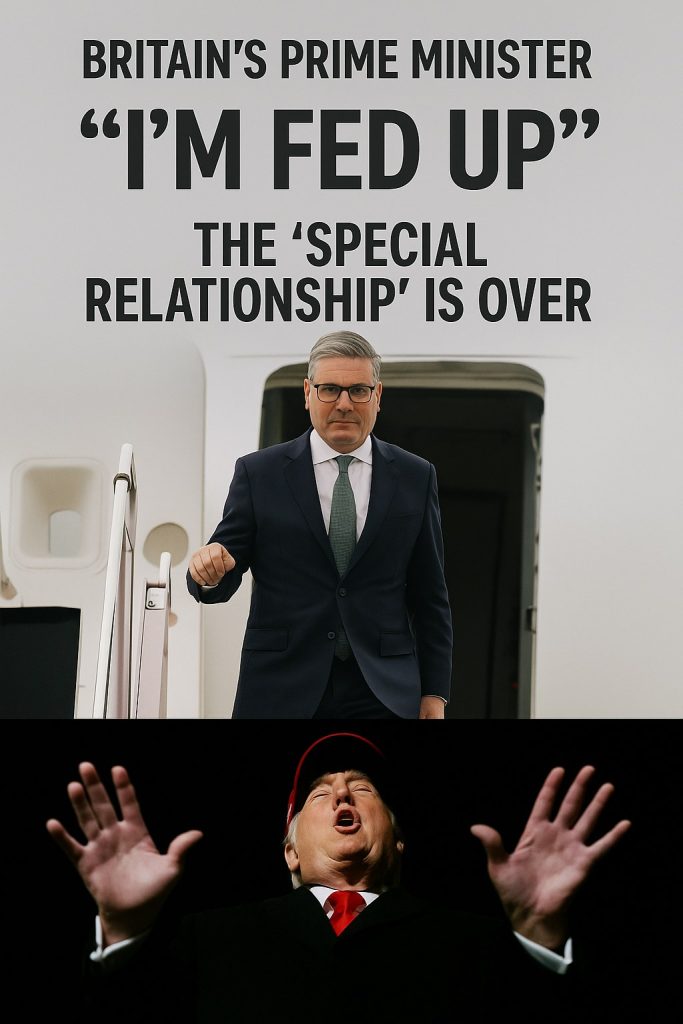
In an unprecedented public rebuke of former US President Donald Trump, Britain’s Labour leader Keir Starmer openly expressed frustration and disillusionment with Trump’s global policies, marking a sharp rupture in the longstanding “special relationship” between the UK and the United States.
During a nationally broadcast interview, Starmer boldly stated, “I’m fed up with the fact that families across the country see their bills go up and down on energy, businesses’ bills go up and down on energy, because of the actions of Putin or Trump across the world.” By placing Trump’s name alongside Vladimir Putin’s—two figures the West has often viewed as adversaries—Starmer directly challenged the former US leader’s role in international instability, a move without precedent in modern British political discourse.
The tensions escalated further when Starmer categorically rejected Trump’s provocative call to blockade the Strait of Hormuz, a critical chokepoint in global oil transport. Trump’s threat to enforce a blockade intended to counter Iran’s regional influence prompted an immediate reaction from Starmer, who declared, “We’re not supporting the blockade. This is not our war and we’re not going to get dragged into it.” This refusal sharply contrasts the UK’s historical alignment with US foreign policies.
Trump, known for his acerbic political style, publicly derided Starmer at a White House Easter event, mocking him as “not Winston Churchill” and likening him to Neville Chamberlain, the British prime minister criticized for appeasing Nazi Germany before World War II. Despite the taunts, Starmer remained resolute, refraining from deploying British naval forces to the Middle East and signaling a new UK stance grounded in independent decision-making and national interest.
This diplomatic schism is not isolated to the UK. Spain has taken the dramatic step of closing its airspace to US military aircraft and denying access to its bases. Prime Minister Pedro Sánchez publicly criticized what he termed those “who set the world on fire just because they show up with a bucket.” Meanwhile, France’s President Emmanuel Macron is spearheading a coalition of European powers intent on defining a foreign policy that sidelines the US.
Even Italy’s Prime Minister Giorgia Meloni, who was considered one of Trump’s closest European allies, has begun distancing herself, breaking ranks in support of a more autonomous European position. In Hungary, Viktor Orbán—often cited as Trump’s favored authoritarian counterpart—suffered a historic defeat in recent elections. Taken together, these developments signal a profound realignment across Europe, as countries reconsider their partnerships and geopolitical strategies in a post-Trump era.
Keir Starmer encapsulated this shift when he announced plans to forge a “closer partnership” with Europe, underscoring the UK’s intention to pivot away from exclusive dependence on the US. The cumulative effect points to the fracturing of the Western alliance that post-World War II architects spent decades building—triggered less by external threats and more by the unpredictable policies and rhetoric of Donald Trump.
While Trump’s presidency was marked by a willingness to upend geopolitical norms, his recent provocations and unilateral actions have arguably done more than spark controversy—they have challenged the very foundations of Western global leadership. As Europe’s power centers pull back from the US, many experts contend that “the American century” may have come to an extraordinary and unexpected close.
Where to Learn More
- Keir Starmer criticizes Trump and refuses support for US blockade – BBC News
- European allies push back against US-led Middle East blockade – The Guardian
- Starmer signals closer UK-EU ties as relations with US cool – Financial Times
- Trump’s strained alliances in Europe mark a turning point – The New York Times
- How Trump’s foreign policy reshaped transatlantic relations – CNN