
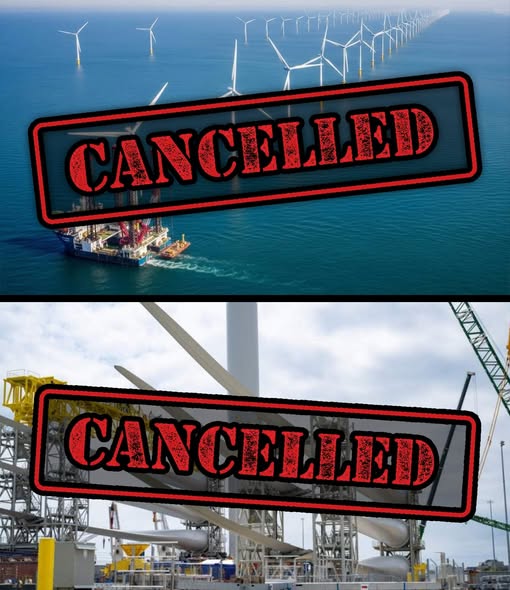
In an alarming display of policy-driven contradiction, the Trump administration is directing nearly $2 billion of taxpayer money to effectively cancel major wind energy projects across the United States. While these green initiatives—such as Bluepoint Wind off New York and New Jersey, Golden State Wind off California, and leases off North Carolina and New York—are abruptly shelved, the administration simultaneously presides over the deteriorating situation at the Strait of Hormuz, a critical chokepoint for global oil supplies.
As these wind projects disappear, they would have powered over a million American homes and contributed to the nation’s clean energy future. Instead, taxpayer dollars are handed over to companies to “cancel” their green ventures, with the stipulation that these corporations reinvest in fossil fuels. This cynical backroom deal ensures billions are funneled into perpetuating dependence on oil—an industry intertwined with geopolitical vulnerabilities and volatile prices. Meanwhile, actual renewable energy capacity in the U.S. stagnates or shrinks.
Simultaneously, the crisis in the Strait of Hormuz has escalated dramatically. Ship traffic through the narrow passage has plummeted to about 5% of normal levels, leaving approximately 230 loaded oil tankers stranded in the Gulf. The blockade has sent global oil prices soaring, with the insurance costs for shipments skyrocketing by $250,000 per trip overnight—a staggering financial burden threatening the stability of energy markets worldwide.
The geopolitical instability highlights a stark contrast in global energy strategies. China, for example, has taken a sharply different route. In 2024 alone, Beijing installed an impressive 87 gigawatts of new wind capacity. With this rapid growth, China now controls 72% of every new wind turbine manufactured globally. Importantly, for the first time in history, China’s combined wind and solar capacity surpasses its coal output, signaling a decisive shift toward renewable energy independence.
While the U.S. government chooses to double down on fossil fuels—paying billions to keep reliance on Gulf oil—China continues to build a clean energy future that seems increasingly out of reach for America. The stark reality is that the cost of fueling a civilization dependent on a chokepoint-controlled fuel source is becoming painfully clear, especially as global instability at the Strait threatens to send energy prices even higher.
The question remains: Why is the U.S. government pouring taxpayer dollars into subsidies that sabotage its own renewable energy potential? As other nations surge ahead with clean energy infrastructure, the current U.S. approach seems rooted in maintaining fossil fuel dominance—regardless of the economic and security risks.
This paradox exposes a broader national dilemma. As the world races toward renewable energy independence, the U.S. lags behind—funded by taxpayer dollars—while geopolitical vulnerabilities grow. The clock is ticking to ask whether continued dependence on oil, controlled through a narrow chokepoint, is sustainable. Or whether it’s time for America to truly invest in the future of energy.
Where to Learn More
- Strait of Hormuz Crisis and its Global Impact – The New York Times
- China leads the world in wind energy expansion in 2024 – Reuters
- U.S. Renewable Energy Progress Report – U.S. Department of Energy
- Oil prices surge as Hormuz Strait blockade intensifies – Bloomberg