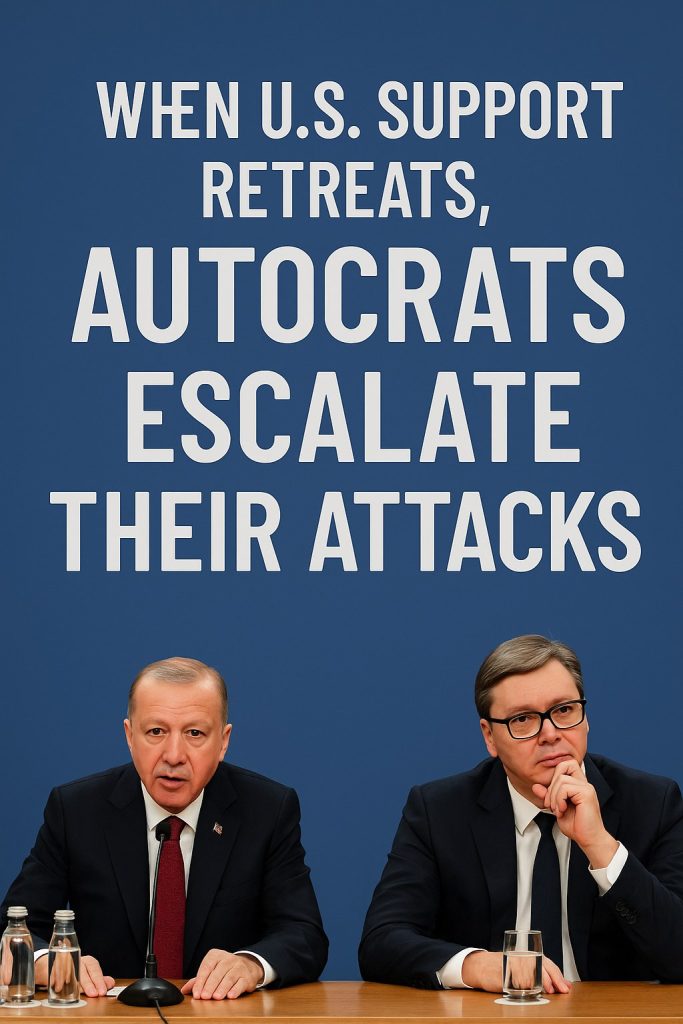
In a rapidly changing geopolitical landscape, the retreat of U.S. support in various regions is allowing autocratic regimes to tighten their grip on power and erode democratic institutions. As highlighted by experts Dan Herman and Robert Benson from the Center for American Progress (CAP), the lack of American backing emboldens authoritarian leaders, who, feeling less accountable, often escalate their attacks on democratic norms and civil liberties.
The global environment is increasingly precarious, as authoritarianism not only survives but begins to flourish in places where democratic movements were once gaining momentum. From Eastern Europe to Latin America, countries facing diminishing support from the U.S. are seeing a troubling trend: leaders flouting laws, suppressing dissent, and crafting narratives that undermine democratic practices.
The withdrawal of American support has exacerbated vulnerabilities in institutions designed to promote democracy, as evidenced by recent developments in nations such as Venezuela and Belarus. Venezuelan President Nicolás Maduro has consolidated power through ruthless measures against opposition forces, while Belarusian President Alexander Lukashenko has faced minimal consequences for his brutal crackdown on protests following a disputed election.
Analysts argue that the U.S. serves as a crucial ally for democratic states; its retreat sends a message of abandonment, creating a vacuum that less scrupulous leaders are quick to fill. Herman and Benson emphasize that “when the protective umbrella of U.S. support begins to fray, it emboldens those who would seek to undermine democracy.”
This phenomenon becomes even more alarming when considering how increased authoritarianism can have a global ripple effect. Countries witnessing a strengthening of dictatorship may inspire others to follow suit, creating a domino effect that results in the diminishing respect for human rights worldwide. The challenge is not just in the immediate implications for a given nation but in how such actions can reshape international norms and standards.
Social media platforms have played a dual role in this process; while they have provided a means of organizing protests and disseminating information among pro-democracy activists, they have also been co-opted by authoritarian regimes to spread disinformation and instill fear. As governments enhance their surveillance capabilities and leverage technology against political opponents, the anonymity and safety previously offered by digital platforms are waning.
In response to these pressing issues, many experts advocate for a renewed and aggressive U.S. commitment to supporting democratic institutions around the world. Regional partnerships with other democracies are crucial for creating a collective resistance against authoritarianism, as well as empowering civil society groups fighting for justice and accountability.
Ultimately, the current global trend shows that when U.S. support wanes, the risks to democracy escalate sharply. Strengthening democratic institutions at home and abroad requires renewed vigor and commitment from the U.S. and its allies, or the world may find itself in an increasingly autocratic era.
Where to Learn More
- When the U.S. Supports Democracies, It Strengthens Their Resilience – Center for American Progress
- World Report 2023: Global Overview – Human Rights Watch
- Democracy Under Siege: Freedom in the World 2023 – Freedom House
- Autocracy vs. Democracy: Evaluating a Resilient Political Order – Brookings Institution
- The State of Democracy: Analyzing Global Trends – C-SPAN