
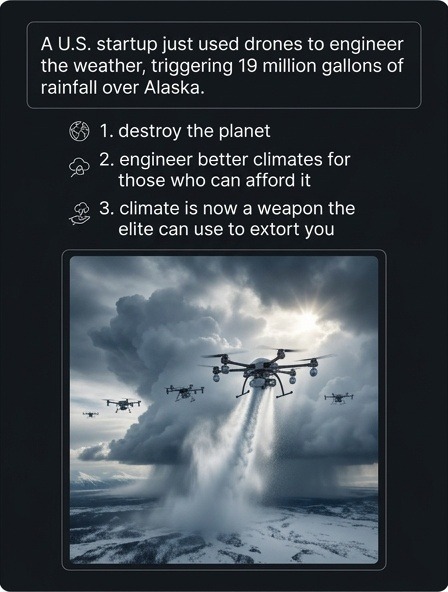
In a groundbreaking development that could revolutionize weather management and climate intervention, a U.S.-based startup has successfully deployed drone technology to engineer the weather, triggering an unprecedented 19 million gallons of rainfall over Alaska. The innovative project, which has gone viral on social media, marks a significant step toward harnessing advanced technology to influence natural weather patterns.
The initiative, led by **Shining Science (@ShiningSci)** — a prominent startup specializing in atmospheric engineering tools — involved deploying a fleet of sophisticated drones equipped with cloud-seeding capabilities to artificially induce rainfall. This effort aims to address persistent drought issues, combat wildfires, and assist in climate resilience efforts by providing on-demand rainfall in targeted regions.
According to the social media post, the operation successfully contained its intense rainstorm over a vast portion of southeastern Alaska, releasing a staggering 19 million gallons of water — enough to fill multiple Olympic-sized swimming pools. The experiment not only demonstrates the potential of drone-based weather engineering but also raises questions about the future of climate intervention technology.
Experts say that while weather modification is not entirely new — cloud seeding has been used for decades — the use of autonomous drones offers unprecedented precision, scalability, and control. By delivering water or seeding particles directly into specific clouds, these drones can potentially manage precipitation more effectively and rapidly respond to climate emergencies.
Dr. Emily Carter, a climate scientist at the University of California, notes, “This development opens a new frontier for weather modification, especially in remote or difficult-to-reach areas like Alaska. However, it also raises important ethical and environmental questions about the unintended consequences of manipulating complex weather systems.”
Alaska, which faces increasing risks from droughts and wildfires, could benefit from such technology, especially during fire season when drought conditions threaten communities and ecosystems. Yet, experts caution that widespread deployment requires rigorous testing, regulation, and international agreement to prevent potential misuse or ecological disruption.
Meanwhile, Shining Science emphasizes that this is just the beginning. The startup is actively refining its drone systems, aiming for more controlled and sustained weather interventions. Future projects could include drought alleviation, flood prevention, and even hurricane mitigation, though those targets remain long-term goals.
The viral social media post has ignited both admiration and debate across platforms, highlighting the transformative potential and the ethical complexities of weather engineering. As technology advances, careful oversight will be essential to ensure these innovations serve humanity responsibly — and do not lead to unforeseen ecological consequences.
Where to Learn More
- Innovations in Cloud Seeding Using Drone Technology – Nature Scientific Reports
- Drones and the Future of Weather Control – Scientific American
- NASA’s Research on Weather Modification – NASA
- Startups Bring Weather Engineering to Remote Areas – The Verge