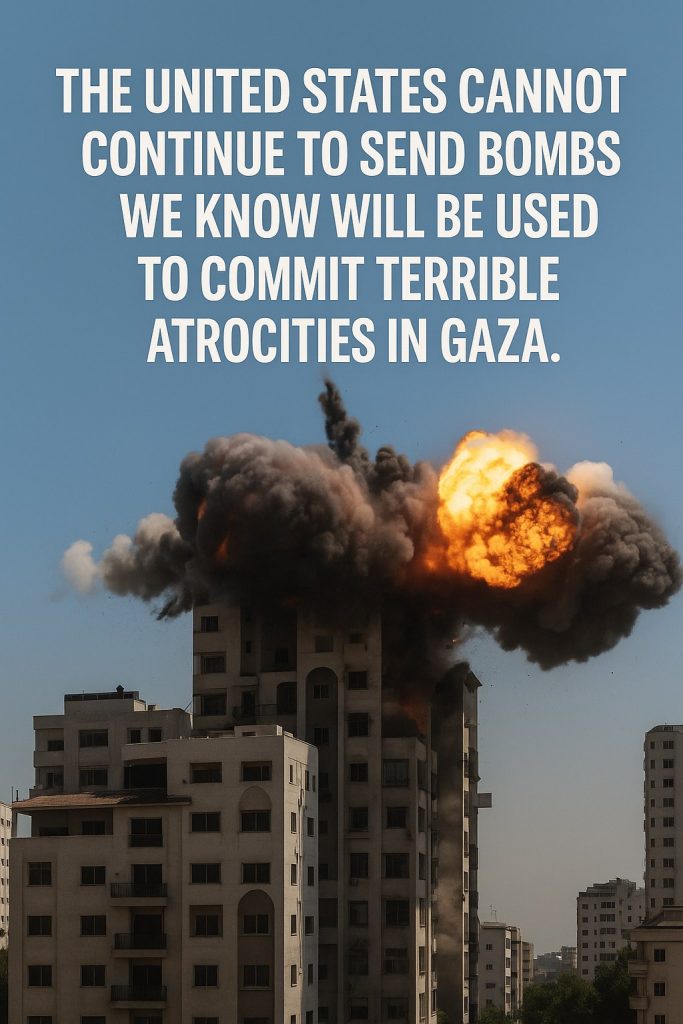
The ongoing conflict in Gaza has sparked widespread outrage and debate, particularly surrounding the United States’ role in supplying munitions to a region embroiled in violence. Recent social media campaigns have ignited discourse with a powerful statement: “The United States cannot continue to send bombs we know will be used to commit terrible atrocities in Gaza.” This statement has resonated deeply, prompting activists, political figures, and ordinary citizens to call for a reevaluation of U.S. military aid to Israel.
As hostilities escalate in Gaza, images of destruction and civilian casualties inundate news feeds worldwide. Many are questioning the ethical implications of U.S. arms sales, particularly as reports show that American-manufactured weapons are being used in strikes that result in significant loss of life among non-combatants. Advocates for peace insist that continuing to supply arms under these circumstances is tantamount to complicity in the ongoing violence.
“We cannot turn a blind eye to the consequences of our military support,” said activist Linda El-Azar during a recent rally in Washington, D.C. “Each bomb represents a loss of life, a family destroyed, and a community shattered.” Her sentiments echo those of countless others who argue that U.S. foreign policy must prioritize human rights and the well-being of civilians over political alliances.
Critics of U.S. arms sales argue that they facilitate a cycle of violence, one that places American moral leadership under intense scrutiny. Political analysts note that the Biden administration’s commitment to Israel’s security does not exempt it from the responsibility to assess the ramifications of these arms sales. Many fear that continued support could exacerbate tensions, undermining long-term peace efforts in the region.
This discussion is fueled by a growing push from advocacy groups who have mobilized their bases to demand a halt to military aid. Prominent organizations such as Human Rights Watch and Amnesty International have released reports detailing the violations of international law in Gaza, urging the U.S. to reconsider its military support amidst evidence of war crimes. These reports add pressure on elected officials, who must balance constituents’ views with long-standing foreign policy positions.
In response to the growing backlash, some lawmakers have begun advocating for reforms in military aid processes. Senator Elizabeth Warren, for instance, has expressed concern over the potential misuse of U.S. weaponry, stating, “We must ensure that our military aid does not contribute to human suffering but promotes peace and security for all.” This represents a significant shift in dialogue within the U.S. Congress, where historically, military support for Israel has been bipartisan, regardless of the humanitarian implications.
The moral imperative to address the consequences of U.S. arms sales is echoed by various civil society groups calling for accountability. They argue that the U.S. has a responsibility not only to uphold international law but to actively promote stability in the region by reducing its military footprint. In a world increasingly concerned with human rights, the fight against atrocities in Gaza is gathering momentum, making it clear that many Americans demand a reexamination of their country’s role in global conflicts.
As this issue continues to unfold, social media will likely remain a crucial platform for raising awareness, facilitating discussions, and mobilizing support. In an age where information spreads rapidly, the sentiment that the U.S. cannot continue to arm perpetrators of atrocities resonates loudly, framing a pivotal conversation on military ethics and foreign policy.
Where to Learn More
- Bombs and Drones: What American Military Aid Looks Like in Gaza – Human Rights Watch
- Unethical Arms Sales: The Crisis in Gaza – Amnesty International
- How U.S. Bombs Are Impacting the Conflict in Gaza – BBC News
- U.S. Arms Sales to Israel: A Controversial Debate in Washington – CNN
- The Impact of U.S. Arms Sales on the Israeli-Palestinian Conflict – The New York Times