
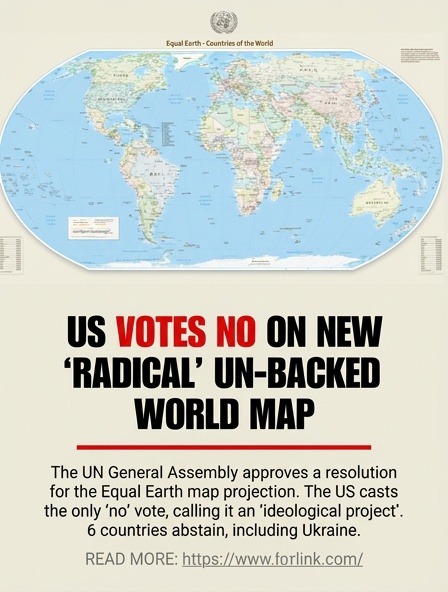
The United Nations General Assembly has made a historic move by approving a resolution to promote the use of the Equal Earth projection, a revolutionary way of mapping our planet that accurately represents the relative sizes of continents. This decision, which garnered overwhelming international support, marks a significant shift in how we visualize the world, emphasizing truthfulness over traditional cartographic conventions.
In a decisive vote of 164 in favor, 1 against, and 6 abstentions, the global body expressed backing for a map projection that challenges the long-dominant Mercator projection. Unlike the Mercator map, which distorts the size of landmasses—making Europe and North America appear disproportionately larger— the Equal Earth projection presents continents in their true proportions. Notably, Africa appears dramatically larger than traditionally depicted, highlighting its actual importance in global demographics and geography.
However, the United States is standing alone in opposition. The U.S. delegate, Deputy Yaryna Ferencevych, explicitly criticized the move, branding the push for the new map as part of a “radical ideological project.” Her comments sparked immediate debate, with critics arguing that the U.S. stance reflects a reluctance to challenge entrenched perceptions and uphold a more accurate, equitable view of the world.
Other nations, including Ukraine, abstained from voting—indicating ongoing discussions about the implications and politics of changing cartographic standards. The movement behind adopting the Equal Earth projection emphasizes its potential to foster a more truthful understanding of global geography, which can influence everything from education to international diplomacy.
Supporters of the new mapping method argue that traditional maps have long been influenced by cultural and political biases. Using a map that accurately depicts landmass sizes fosters a more realistic perspective, especially in areas like Africa and South America, which are often underrepresented on conventional maps. Advocates hope this shift will lead to broader awareness of global inequalities and promote a more balanced view of the world.
The U.N. resolution signifies more than just a change in cartography; it underscores an ongoing global conversation about truth, representation, and perspective. While only one country votes “no,” the conversation about how we see and understand our world is definitely gaining momentum.
Where to Learn More
- U.N. votes 164-1 in favor of new map projection, US opposes – Fox News
- The Equal Earth Map: Rethinking World Geography – National Geographic
- United Nations: Advocating for Fair Representation in Maps – U.N. Official Site
- How a New Map Projection Could Change Our View of the World – BBC News