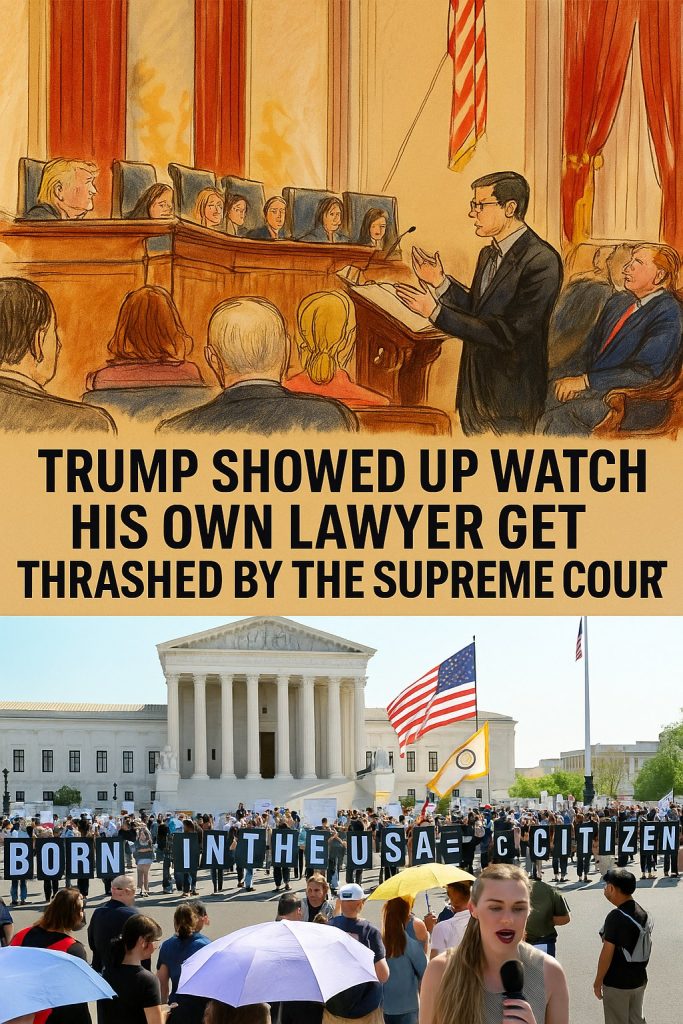
In a historic first, former President Donald Trump made an unprecedented in-person appearance at the Supreme Court to witness oral arguments in the administration’s highly contentious bid to overturn birthright citizenship. The proceedings quickly proved a disaster for Trump’s legal team, with the justices — including several he personally appointed — methodically dismantling the government’s case over the course of a tense two-hour hearing.
Solicitor General John Sauer, representing the government, argued that transformative societal changes since the ratification of the 14th Amendment in 1868 warranted a reevaluation of the constitutional guarantees of birthright citizenship. But Chief Justice John Roberts, known for his decisive and often centrist approach, was quick to reject this line of reasoning. “Well, it’s a new world. It’s the same Constitution,” Roberts asserted firmly, signaling his unwillingness to deviate from the text and original meaning of the 14th Amendment despite modern developments.
Justice Ketanji Brown Jackson, adept at probing practical implications, questioned Sauer on the feasibility of the administration’s theory in real-world scenarios. “Is this happening in the delivery room?” she inquired pointedly, highlighting the administrative and legal chaos that could ensue from undermining longstanding birthright citizenship provisions.
Perhaps the most striking moments came from Justice Amy Coney Barrett, a Trump appointee who turned the spotlight on the government’s historical arguments. Sauer contended that the 14th Amendment was intended primarily to protect the rights of freed slaves and thus did not extend to current birthright claims. Barrett delivered a sharp critique: “That’s not textual. How do you get there?” When Sauer attempted to shift the focus toward federal statutes, Barrett cut through the evasions with a direct demand: “Yeah, but what about the Constitution?”
Despite the high drama unfolding in the courtroom, Trump departed after roughly 75 minutes, shortly after his own lawyer concluded arguments. He did not remain to hear the subsequent defense mounted by the American Civil Liberties Union (ACLU), which thoroughly challenged the administration’s position. Instead, Trump retreated to his social media platform Truth Social, where he unleashed a barrage of misleading claims, including that the United States was “the only Country in the World STUPID enough to allow Birthright Citizenship.” This statement was easily debunked by experts: over 30 countries worldwide, including Canada and Mexico, grant birthright citizenship without restrictions.
The optics of a sitting or former president storming out of the Supreme Court mid-hearing and immediately posting inaccurate information online painted a picture of a deeply faltering legal strategy and a team struggling under intense judicial scrutiny.
The trajectory of the case has repeatedly tilted against the administration, with every lower court to review the executive order striking it down as unconstitutional. Today’s Supreme Court session, featuring a panel of justices attentive, skeptical, and at times sharply critical of the government’s logic, suggests the high court is poised to continue this trend. A ruling is expected by early summer, and if today’s exchanges serve as any forecast, Trump’s ambitions to overturn over 150 years of constitutional precedent are headed for a resounding defeat.
This episode not only underscores the strength of the constitutional framework surrounding birthright citizenship but also highlights the limits of executive power when faced with rigorous judicial examination — even when former presidents personally attend their case’s arguments.
Where to Learn More
- Inside the Supreme Court Argument on Birthright Citizenship – The New York Times
- Supreme Court Justices Challenge Trump Administration’s Birthright Citizenship Case – The Washington Post
- Analysis of Today’s Supreme Court Arguments on Birthright Citizenship – SCOTUSblog
- ACLU Statement on Trump’s Birthright Citizenship Lawsuit – American Civil Liberties Union