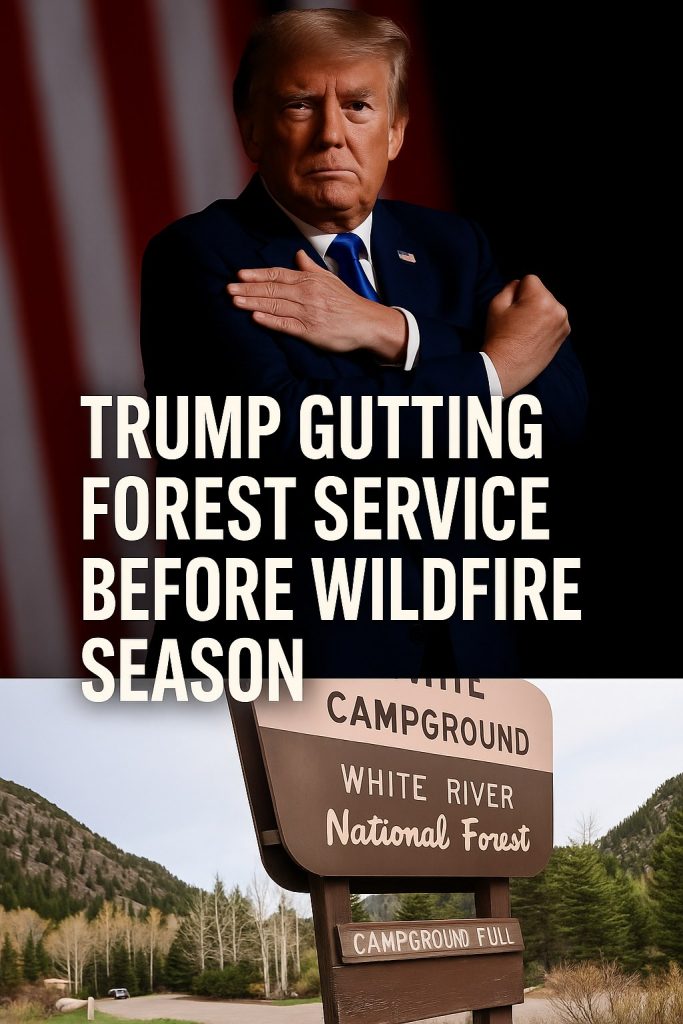
For 120 years, the U.S. Forest Service has stood as the steadfast guardian of nearly 200 million acres of America’s forests, grasslands, and watersheds. These public lands are treasured by hikers, hunters, families, and countless communities downstream who rely on healthy forests for clean air and water. Yet, as wildfire season rapidly approaches, the Trump administration is radically restructuring this historic agency—sparking alarm among scientists, firefighters, lawmakers, and conservationists nationwide.
What the administration calls “streamlining” amounts to widespread closures and upheaval: every regional Forest Service office is shutting down, 57 of 77 research facilities are being shuttered, and the agency’s headquarters is moving from Washington, D.C., to Salt Lake City. The fallout is real and immediate. Career scientists and veteran firefighters have been given an ultimatum—relocate hundreds of miles or resign.
Meanwhile, the outlook for wildfire risk this year is grim. Federal forecasts warn of an exceptionally high fire season across the western United States. By the end of March, wildfires had scorched 1.6 million acres nationwide—an unbelievable 231% above the 10-year average. Snowpack levels remain at historic lows, leaving the land bone dry and highly vulnerable.
Under these critical conditions, one might expect the government to bolster, not dismantle, its firefighting infrastructure. Yet an analysis by the nonprofit Grassroots Wildland Firefighters revealed that wildfire mitigation work under Trump dropped by 38% last year compared to prior seasons. Trail maintenance is at a 15-year low, and despite promises that firefighting capacity wouldn’t be cut, hundreds of “red-card-certified” wildfire responders were let go—only to be urgently recalled as fires blazed across the West.
The administration maintains that this latest round of disruption won’t affect firefighting on the ground. But skeptics remain unconvinced. At the Pacific Wildland Fire Sciences Laboratory in Seattle, a critical hub where researchers model fire hazards and study wildfire impacts on ecosystems and community health, staff face layoffs as the facility is slated for closure. These scientists play a vital role in foreseeing and preventing disasters before flames spread uncontrollably.
“We are about to see a potentially catastrophic wildfire season,” warned Senator Michael Bennet (D-CO). “This reorganization cannot distract from the work ahead.” The Forest Service has a critical mission: a mission potentially undermined at its most vulnerable moment.
Union leaders also point to legal barriers, emphasizing that the 2026 budget contains explicit language forbidding funds from being used to relocate offices or reorganize the agency. Yet Congressional Republicans have largely remained silent on this issue, raising questions about accountability.
The forests will undoubtedly remain standing long after the Trump administration’s tenure ends. But the pressing question is whether the nation will still have the expertise and resources needed to protect these lands from destruction.
As wildfire season looms larger every year, the fate of America’s forests has never felt more precarious.
Where to Learn More
- U.S. Forest Service Official Website – U.S. Department of Agriculture
- Forest Service Restructure Draws Criticism Ahead of Fire Season – Wildfire Today
- Wildfires and Climate Change – Natural Resources Defense Council (NRDC)
- The Future of America’s Forests: Challenges for the U.S. Forest Service – National Wildlife Federation
- Budget Language on Forest Service Funding and Restrictions – Congress.gov