
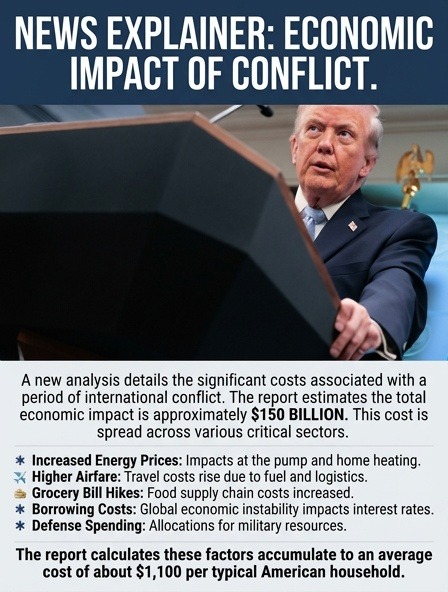
Recent social media discussions are shedding light on the significant financial toll of former President Donald Trump’s foreign policy decisions, described by many as an “illegal war of choice.” According to analysts and economic experts, this costly policy shift is indirectly impacting every American household by approximately $1,100.
How is this possible? The figures stem from a comprehensive estimate of around $150 billion in secondary costs across multiple sectors. These expenses include increased prices for energy and airfare, higher grocery bills, elevated borrowing costs, and increased defense spending—a ripple effect that translates into a tangible burden for everyday Americans.
“This isn’t just about geopolitics or foreign policy,” explains political economist Dr. Laura Jensen. “It demonstrates how international decisions can have far-reaching economic consequences, especially when they escalate conflicts or trigger instability.”
One of the largest contributors to these rising costs is energy. With the escalation of military tensions, energy prices—particularly oil and natural gas—have surged, impacting fuel costs and, consequently, transportation expenses. This surge has ripple effects on airfare and shipping costs, fueling inflation in the travel industry and beyond.
Meanwhile, grocery prices have climbed due to disruptions in global supply chains, which are exacerbated by instability in key regions, often linked to geopolitical conflicts. Borrowing costs have also increased as the Federal Reserve responds to inflationary pressures, further straining household budgets.
On the defense front, rising military expenditures have played a role. While defense budgets are often justified for national security, critics argue that the timing and scope of recent policies have unnecessarily escalated tensions, leading to costs that Americans bear indirectly through higher taxes and economic ripple effects.
Social media users are calling for accountability, emphasizing that these costs are largely driven by policy choices that many believe violate international law. They warn that such expenditures do not just impact government budgets—they hit the wallets of ordinary Americans, especially those already struggling with inflation and economic uncertainty.
This startling figure—$1,100 per household—serves as a stark reminder of how international decisions can have personal economic consequences. As debates continue over foreign policy priorities, many are demanding greater transparency and accountability for how these decisions affect everyday lives in the United States.
Where to Learn More
- Analysis of the Economic Impact of Recent Foreign Policy Decisions – The New York Times
- How Military Spending and International Conflicts Drive Up Costs for Americans – CNN
- The Hidden Cost of U.S. Foreign Policy on Ordinary Americans – Bloomberg
- Examining the Financial Toll of Trump’s Foreign Policy Choices – Forbes