
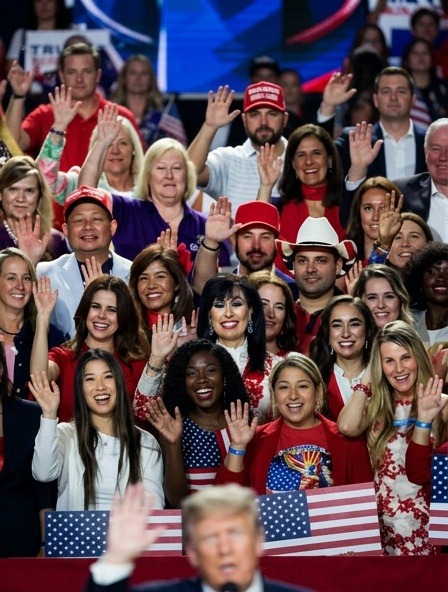
In recent days, former President Donald Trump continues to spread false claims about the state of the U.S. economy and America’s position on the world stage. During a series of rallies and social media posts last week, Trump reiterated his familiar and baseless assertions, claiming that the current economy is a “disaster” and that the U.S. has “fallen behind” other nations—a stark contrast to the facts acknowledged by economists and foreign policy experts.
Despite undeniable evidence showing steady economic growth, low unemployment, and increased global influence under the current administration, Trump’s false narrative persists. He argues that the economy is “crashing,” citing imaginary crises and misrepresenting data to fit his political narrative. Similarly, he repeatedly claims that the United States is no longer a “superpower,” suggesting that other countries have overtaken us economically and militarily. These assertions have been universally debunked by experts but continue to resonate with his core supporters.
Why is this so significant? Because Trump’s persistent misinformation not only distorts facts but also exposes the Democratic Party’s ongoing struggle to craft a coherent counter-message. Democratic strategists face the complex challenge of addressing a candidate who seemingly operates outside conventional truth-telling, making it difficult to engage in straightforward rebuttals. As Trump doubles down on these falsehoods, Democrats find themselves often caught in a defensive stance, trying to correct narratives that are carefully repeated with little regard for facts.
Many political analysts note that Trump’s messaging taps into deeply felt frustrations among a segment of the American electorate—fears about declining U.S. global dominance and economic stability. However, they argue that his rhetoric is detached from reality, serving to fuel polarization instead of fostering informed debate.
Additionally, the ongoing circus of misinformation complicates efforts for the Democratic leadership to articulate a clear, unified stand. While they underscore tangible progress—such as job growth and international agreements—the unfounded claims of decline undermine these messages. This disconnect leaves many ordinary voters confused and vulnerable to misinformation, which plays right into Trump’s narrative of decline and chaos.
As the political season heats up, observers warn that if Democrats do not develop more effective strategies to challenge these exaggerated claims, they risk playing into Trump’s game of distraction and disinformation. The key will be emphasizing factual, accessible communication that can cut through the noise, something that remains elusive in today’s partisan environment.
In conclusion, Trump’s recent spree of fabricated claims underscores the importance of media literacy and fact-based discourse in American politics. His willingness to repeat lies raises serious questions about the future of political debate and the resilience of truth in the public sphere. Meanwhile, Democrats—faced with a maneuvering opponent—must adapt quickly to maintain clarity and credibility amid the chaos.
Where to Learn More
- FactCheck.org – Nonpartisan site dedicated to fact-checking political claims
- Washington Post Politics Section – In-depth analysis of recent political discourse
- New York Times Politics – Coverage of the latest statements from Trump and Democratic responses
- Brookings Institution – Expert commentary on American economic and foreign policy
- CNN Politics – Up-to-date reports on political rhetoric and campaign strategies