
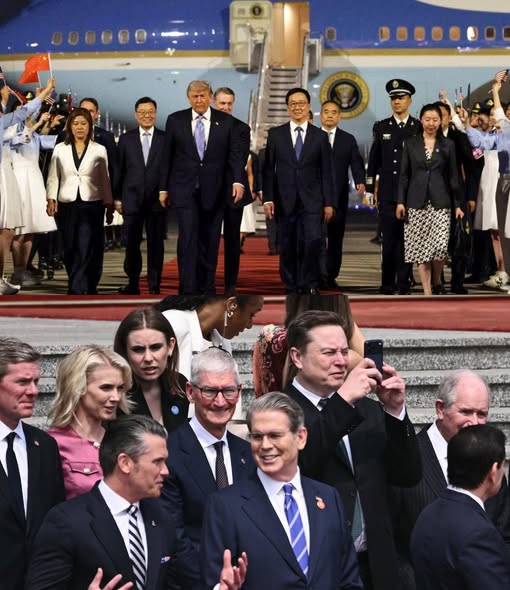
In a move that has raised eyebrows across the political and economic spectrums, former President Donald Trump recently took a controversial trip to Beijing aboard Air Force One, accompanied by a hand-picked entourage of some of the world’s most powerful billionaires. This high-stakes visit, featuring a gold-plated delegation worth over a trillion dollars collectively, signals a startling shift in diplomacy—a private lobbying effort on foreign soil aimed squarely at China’s leadership.
Among those onboard were Elon Musk, the billionaire CEO of Tesla and SpaceX, whose net worth is estimated at over $819 billion; Jensen Huang, Nvidia’s founder and CEO, valued at approximately $183 billion; Stephen Schwarzman of Blackstone, with a fortune around $47.5 billion; and top executives from giants like Apple, Goldman Sachs, BlackRock, Citi, and Boeing. Interestingly, the entire delegation was reportedly assembled to personally influence Chinese President Xi Jinping, with reports claiming Trump told Xi that these “brilliant people” need China to “open up” so they can “work their magic,” effectively pleading for relaxed market access to boost their bottom lines.
Photos from the tarmac captured Trump carrying the delegation’s bags—an image that has ignited social media outrage and sparking debates about the optics of such a visit. Critics argue this is emblematic of a troubling trend where American policymakers prioritize private corporate interests over national concerns and the welfare of American citizens.
Adding an odd twist to this high-profile business trip: the presence of filmmaker Brett Ratner, who faced sexual misconduct allegations in 2017, casting a shadow over the delegation’s prestige. The combined assembly of billionaires, government officials, and a controversial Hollywood figure paints a portrait of a deeply interconnected elite fueling global economic negotiations far removed from everyday American concerns.
Meanwhile, back in the United States, the Trump administration’s domestic policies tell a starkly contrasting story. Last July, he signed what the Center for American Progress called the largest tax and budget cuts to social safety net programs in U.S. history. These cuts threaten to deprive approximately 10.9 million Americans of health coverage and eliminate food assistance for 2.4 million by 2034. Programs like Medicaid, SNAP, WIC, LIHEAP, and Section 8 housing vouchers face deep, painful reductions, leaving vulnerable populations grappling to meet basic needs.
Critics argue that these domestic austerity measures starkly contrast with the lavish, globalist efforts of the billionaire entourage in China, exposing an administration prioritizing billionaire profit over the health and well-being of everyday Americans. As President Trump personally advocates for multinational corporate interests abroad, working families struggle to keep food on the table and a roof over their heads at home.
This paradox—a President proving himself a personal concierge for billionaires while stripping resources from the most vulnerable—is fueling ongoing debates about true allegiance in American politics. Is this leadership or deliberate neglect? As the world watches, the image of Trump on the tarmac with China’s leader and his elite crew serves as a stark visual symbol of economic privilege and political disparity.
Where to Learn More
- Analysis of U.S.-China Relations and the Biden-Trump Policy Shifts – C-SPAN
- Center for American Progress: Trump’s Historic Social Program Cuts
- The New York Times: Inside Trump’s Secretive Trip to China with a Billionaire Lobbying Squad
- Wall Street Journal: Trump’s Chinese Visit Highlights Complex Ties Between Wealth and Power
- ProPublica: The Billionaires Behind Trump’s Foreign Lobbying Efforts