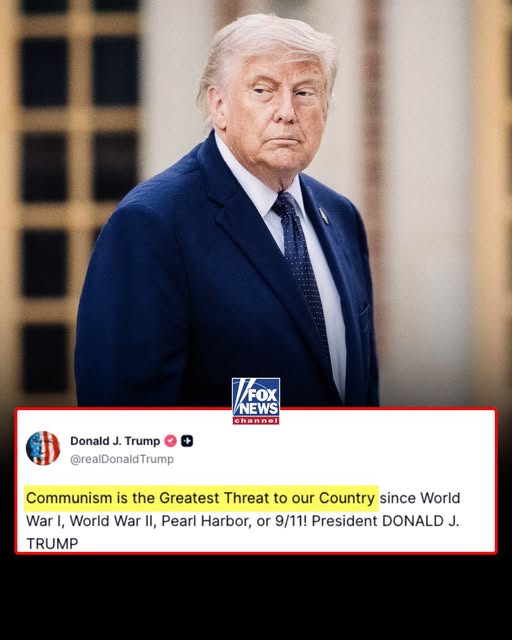
In a move that has sparked widespread debate and intense media coverage, former President Donald Trump has issued a stark warning, declaring that “Communism is the greatest threat to our country since World War I, World War II, Pearl Harbor, or 9/11.” This statement was shared via a social media post that rapidly went viral, highlighting Trump’s deepening polarization of political discourse amidst recent election developments.
Just days after socialist Democrats achieved notable victories in New York’s primary elections, Trump’s rhetoric has taken on a more urgent tone. Critics argue that his comments are part of a broader strategy to energize his base by portraying the political left as an existential threat to America’s foundational principles. Supporters, however, see his remarks as a necessary wake-up call, warning Americans of what they perceive to be rising socialist and communist ideologies within the current political landscape.
The controversy further intensified when Trump targeted Washington, D.C., mayoral candidate Janeese Lewis George, labeling her a “communist” and vowing to prevent her policies from “destroying” the nation’s capital. This remark has alarmed many political analysts, who view it as an escalation in the ongoing political battles over ideology and governance reform in the U.S. capital.
Historically, Trump’s fiery rhetoric has served as a signature aspect of his political persona, often aiming to rally supporters by framing issues as existential threats. In this case, he emphasized the danger he perceives from what he describes as the dangerous rise in socialist policies, which he equates with a threat comparable to the nation’s most defining, yet tragic, moments in history.
Many political commentators have expressed concern that such rhetoric could deepen partisan divides and potentially lead to increased social tensions. Experts warn that framing communism — an ideology that was once a global superpower — as an imminent threat risks oversimplifying complex political issues and fueling misinformation.
Meanwhile, Democrats dismiss Trump’s claims as hyperbolic and fear-mongering, emphasizing the importance of rational debate rooted in facts rather than fear. The Biden administration and mainstream media continue to advocate for a focus on pragmatic policies rather than alarmist rhetoric that could further polarize the nation.
As the political climate heats up ahead of upcoming elections, Trump’s inflammatory language underscores a broader battle over America’s identity and future. Whether this rhetoric will sway voters or deepen divisions remains to be seen, but it undeniably marks a tense chapter in the ongoing political saga.