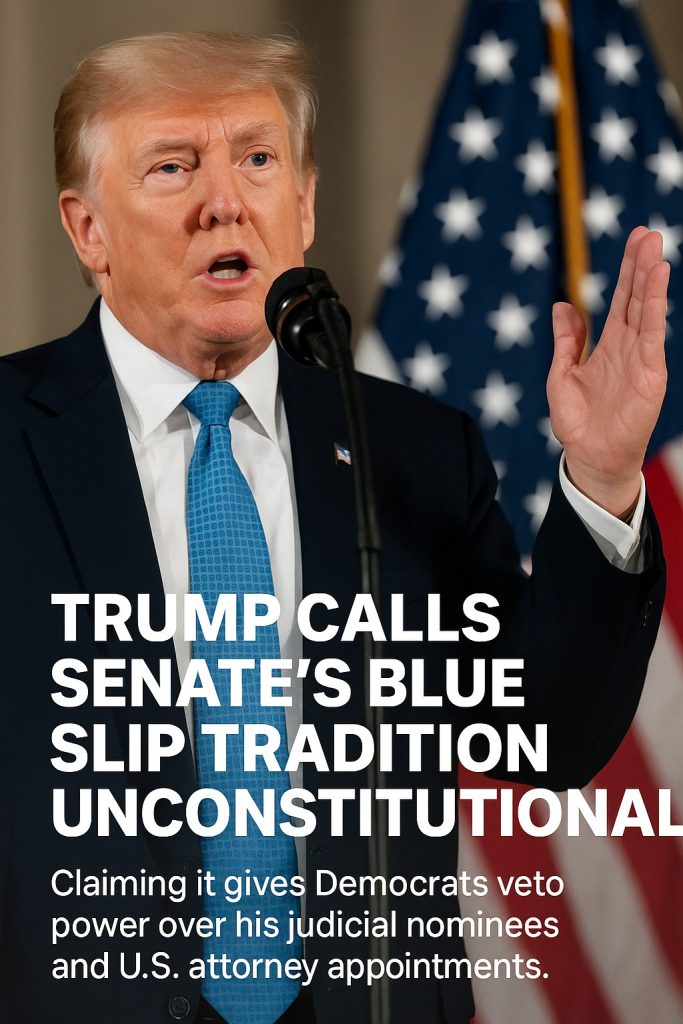
Former President Donald Trump has publicly challenged the longstanding Senate blue slip tradition, asserting that the practice is unconstitutional and unfairly empowers Senate Democrats with a de facto “veto” over his judicial nominees and U.S. attorney appointments. This recent statement comes amid ongoing tensions over judicial confirmations and partisan battles shaping the federal judiciary.
The blue slip process, a Senate custom dating back decades, allows home-state senators—regardless of party—to approve or block judicial nominees from their state by returning a blue approval slip. Traditionally, this courtesy helps the Senate Judiciary Committee gauge local support before moving forward with confirmation votes. However, critics argue that the process has increasingly become a political tool to stall or thwart nominees, especially in periods of heightened partisan polarization.
Trump’s contention centers around the blue slip’s power being wielded primarily by Democrats when Senate control shifts, particularly impacting judges and U.S. attorneys aligned with Republican administrations. In a recent statement, Trump declared the tradition “unconstitutional”, claiming it violates the president’s authority under Article II of the U.S. Constitution to recommend and appoint federal judges with the Senate’s advice and consent—not unilateral senatorial approval.
“The blue slip process has been weaponized by the Democrats to keep my nominees out of the courts and prevent appointments of U.S. attorneys who uphold the rule of law,” Trump said. He described the tradition as granting minority party senators an “unfair veto,” undermining the president’s power to shape the judiciary and enforce federal laws.
Legal scholars and Senate insiders note that while the blue slip is not a formal Senate rule codified in law, it has been a powerful procedural custom respected by Judiciary Committee chairs across administrations. Its enforcement varies based on the majority party’s preferences, leading to inconsistent applications and strategic usage. Some past chairs have allowed nominees to proceed without a favorable blue slip, while others have strictly adhered to the tradition.
The dispute also touches on the appointment of U.S. attorneys, key federal prosecutors whose confirmation typically requires Senate approval. Trump’s charges suggest that Senate Democrats have been leveraging blue slips to block these nominations, complicating efforts to install loyalists in key prosecutorial roles.
With the 2024 election cycle underway and control of Congress hanging in the balance, this conflict highlights the broader political struggle over judicial appointments—one that shapes the courts’ ideological makeup for generations. Trump’s denunciation of the blue slip mechanism serves both as a rallying cry for his base and a critique of Senate procedural norms that may hinder his influence should he return to the presidency.
Legal experts caution, however, that striking down or circumventing the blue slip tradition may inflame Senate partisanship further, erode collegial customs, and trigger more contentious confirmation battles.
As the debate intensifies, Senate leaders and Judiciary Committee members face pressure to clarify the role of blue slips in the confirmation process, balancing tradition with evolving political realities. For now, Trump’s public repudiation of the blue slip tradition underscores how procedural Senate practices remain a pivotal yet often overlooked front in the fierce struggle over the federal judiciary.