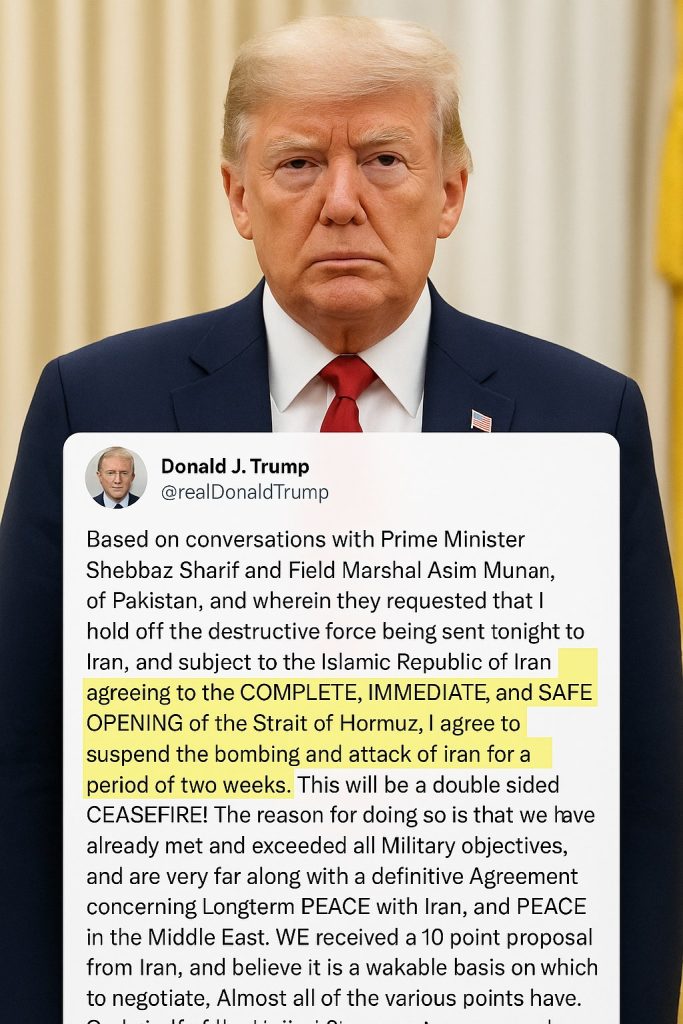
In a stunning development late today, President Donald Trump agreed to a two-week ceasefire with Iran, conditionally halting all bombing and offensive attacks in exchange for the reopening of the strategically vital Strait of Hormuz.
The Oval Office announcement, delivered with President Trump seated at the Resolute Desk, signaled a fragile but hopeful step toward easing longstanding tensions between the U.S. and Iran. Trump emphasized the temporary nature of the ceasefire, making it clear that the cessation of attacks will last precisely two weeks “to provide a crucial window to finalize a long-term peace agreement.”
“Negotiations are very far along,” the president said, underscoring that his administration has been in ongoing discussions aimed at de-escalating the volatile conflict that has roiled the Persian Gulf region and jeopardized global oil shipments.
The Strait of Hormuz, a narrow but critical maritime passage through which roughly 20% of the world’s petroleum passes, has been at the center of escalating conflict over the past months. Iran’s decision to close or restrict transit through the strait had sparked fears of a major international crisis, pushing oil prices higher and increasing military alertness from global powers.
Under the terms outlined by President Trump, the United States will suspend all bombing and offensive actions targeting Iran’s military and nuclear infrastructure for 14 days. During this period, both sides are expected to engage in intensive talks to solidify a comprehensive peace deal that could prevent future conflict and stabilize the region.
The president’s announcement comes amid mounting pressure from allies and international organizations urging restraint and diplomatic solutions. The Middle East and global markets had been closely watching every move, hopeful that conflict would be averted and a pathway to peace created.
Experts note that while the two-week window offers an unprecedented opportunity for dialogue, the path to a lasting peace remains complex and fraught with challenges. Iran’s willingness to reopen the Strait hinges on confidence that the U.S. will honor its commitment and take meaningful steps during the ceasefire to address their concerns.
White House officials described the ceasefire agreement as a breakthrough moment that could redefine U.S.-Iran relations after years of hostility, sanctions, and brinkmanship.
President Trump concluded his statement with a call for unity and patience: “We are at a crossroads. The choices we make now will shape the future for millions, and I remain optimistic that peace is within our grasp.”
As the world watches closely, the coming two weeks will be critical in determining whether this tentative ceasefire marks the beginning of a durable peace or another pause in a continuing conflict.