
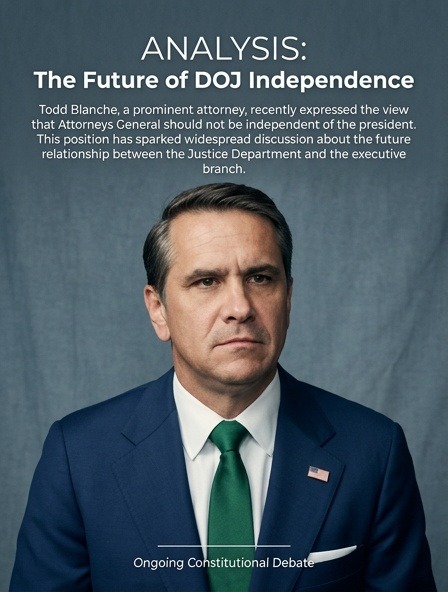
In a recent interview that has quickly gone viral on social media, Todd Blanche, a prominent legal figure associated with the Department of Justice, made remarks that challenge longstanding norms about judicial independence in the United States. When asked whether his DOJ would maintain independence from President Donald Trump, Blanche refused to give a definitive answer. Instead, he went further—suggesting that **all Attorneys General should not be independent of the president**.
Blanche’s statements have sparked a flurry of debates across political and legal spheres about the role of the Attorney General and the balance of power between the executive branch and the justice system. Traditionally, U.S. Attorneys General are expected to operate free from political influence, ensuring that justice is administered fairly and without undue interference. However, Blanche’s comments appear to undermine that core principle, raising alarms among legal experts and advocates for accountability.
When pressed about whether his department would remain independent from President Trump, Blanche sidestepped the question. Instead, he expressed a provocative viewpoint: *”The idea that Attorneys General should be completely independent from the president is something we need to reconsider. Perhaps it’s better if they are more aligned with the administration’s vision to ensure smoother governance.”* While he did not explicitly endorse political interference, his comments have been perceived by critics as endorsing a more politicized approach to the Justice Department.
What truly caught people’s attention, however, was Blanche’s assertion that the independence of Attorneys General shouldn’t be an absolute. He implied that a closer relationship—potentially even subservience—could benefit the institution, especially under a presidency like Trump’s, where he suggested that close alignment might be necessary for effective governance. This stance has reignited concerns about the potential erosion of checks and balances within the U.S. government system.
Legal analysts warn that such views could jeopardize the integrity of the Justice Department’s role as an impartial arbiter. “If top law enforcement officials view their independence as negotiable or subordinate to political interests,” said constitutional scholar Dr. Lisa Reynolds, “it undermines the very foundation of law-based governance. The independence of the DOJ is vital to maintaining public trust.”
Public reaction has been swift and divided. Supporters argue that a more integrated relationship between the Justice Department and the presidency can facilitate swift decision-making on national security and policy matters. Critics, however, warn that this approach could lead to politicization of legal processes, potentially eroding faith in American institutions.
Blanche’s remarks come at a time of heightened scrutiny over the independence of the DOJ, particularly amid ongoing investigations linked to Trump and efforts to scrutinize government actors’ roles. As political debate continues, the debate over the proper independence of attorneys general remains a critical issue shaping the future of American governance.
Where to Learn More
- “Legal Experts React to Todd Blanche’s Controversial Comments on DOJ Independence” — The New York Times
- “Analysis: What Blanche’s Remarks Mean for the Future of Justice Department Autonomy” — The Washington Post
- “Fact Check: Are All Attorneys General Supposed to Be Loyal to the President?” — CNN
- “US Legal System Under Scrutiny Amid Debate Over Department Independence” — BBC News
- “The Threat to Justice Department Independence” — The Economist