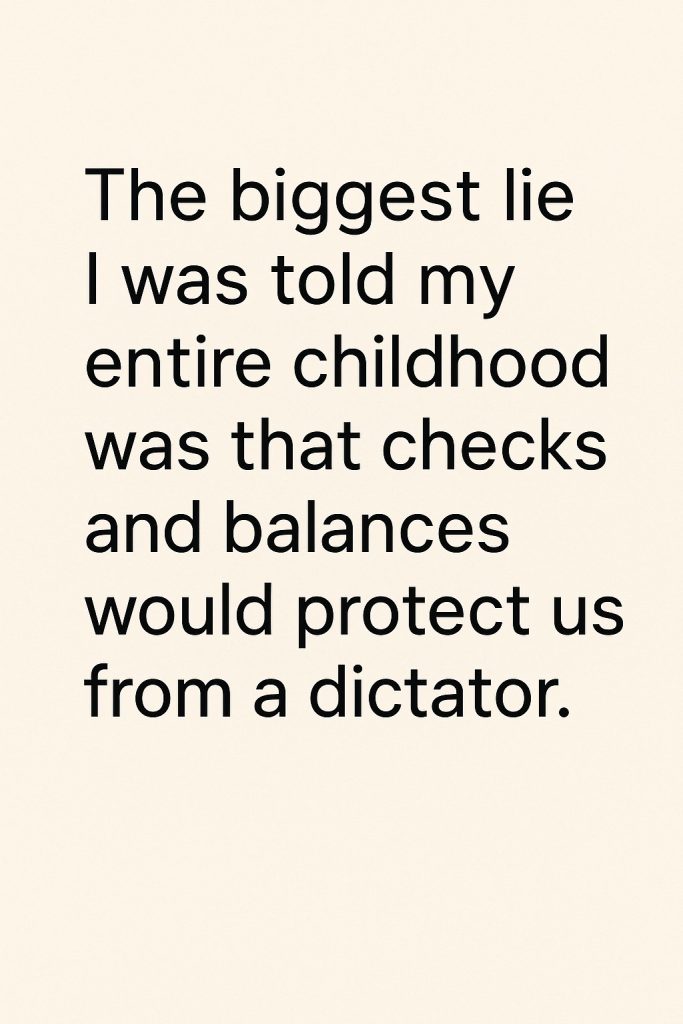
In an age where social media can amplify thoughts with a single click, a recent viral post featuring a powerful statement has resonated deeply with users across various platforms. The message, which reads: “The biggest lie I was told my entire childhood was that checks and balances would protect us from a dictator,” has sparked a wave of discussions surrounding political structures, governance, and the delicate fabric of democracy.
Initially shared on Threads by user @creativejordan, this sentiment captures a growing disillusionment among many regarding the effectiveness of institutional safeguards designed to uphold democracy and prevent the rise of authoritarianism. The simplicity of the statement belies the complexity of the emotions and fears it evokes, tapping into a collective anxiety about the current political climate in many democracies around the world.
For generations, the tenet of checks and balances has been touted as a cornerstone of democratic governance, aimed at preventing any single entity from wielding too much power. However, as recent political events globally have unfolded, prompting many to feel that these systems are faltering, it’s understandable why some are questioning the efficacy of these safeguards.
Historically, checks and balances became prominent in the writings of Enlightenment thinkers like Montesquieu, who argued that separating governmental powers into distinct branches would thwart tyranny. Yet, critics argue that as political polarization intensifies, these safeguards can become as much a hindrance as a help, often leading to gridlock instead of effective governance.
The post has generated a vibrant dialogue online, with users sharing experiences, opinions, and drawings on how reality has often contradicted the lessons taught to them as children. Many express feelings of betrayal that systems they were led to believe would protect their rights and democracy have failed to do so under stress.
Among those engaging in this conversation are political analysts, educators, and concerned citizens. They remind us that the principles of democracy do not guarantee perfection but rather a framework to facilitate the protection of civil liberties. However, as these safeguards are being tested in various countries with varying degrees of success, the question remains — are they strong enough to work against modern-day threats?
Social media has played a crucial role in politicizing public sentiment, forming communities around shared grievances and, intriguingly, enabling individuals to find solidarity in existential fears. The power of platforms like Threads or Twitter provides a unique outlet for people to discuss their feelings on a larger stage, doing so in ways that traditional forums might not accommodate.
The conversation surrounding checks and balances is not just academic; it resonates with the lived experiences of individuals globally who are directly impacted by political leadership. As more people reflect on the protections they were once assured, the call to evaluate and potentially reform these systems grows louder. The popularity of the post underscores the importance of civic engagement and vigilance in a democracy.
As @creativejordan’s statement continues to circulate, it is likely to inspire further discourse and advocacy — reminding us that in a world where leadership is ever more contentious, vigilance and participation remain crucial in safeguarding democracy.
Where to Learn More
- The Checks and Balances of U.S. Democracy – Brookings Institution
- The Rocky Road of Checks and Balances – The Atlantic
- Does Checks and Balances Strongly Protect Us? – C-SPAN
- Checks and Balances Are Not Enough – The New York Times