
In a remarkable achievement for conservation efforts, India has successfully doubled its tiger population in the decade leading up to the COVID-19 pandemic, as highlighted by a recent study.
Back in 2010, countries with existing tiger habitats established an ambitious goal known as Tx2 during the St. Petersburg International summit on tiger conservation. The aim was to double the global wild tiger population by 2022, a year that coincides with the Year of the Tiger in the Chinese zodiac. This timeline allowed nations across the Indo-Pacific, East and South Asia, and Russia to effectively implement measures supporting tiger conservation.
By 2022, it was estimated that this goal had been met globally, but certain regions celebrated even more significant victories. Notably, both Nepal and India have seen their native tiger populations double. Despite being the world’s most populous country, India managed to create a safe haven for tigers across an impressive area of 53,360 square miles. By 2018, the number of native tigers in India soared above 3,600, representing 75% of the planet’s total tiger population and double the estimates from 2006.
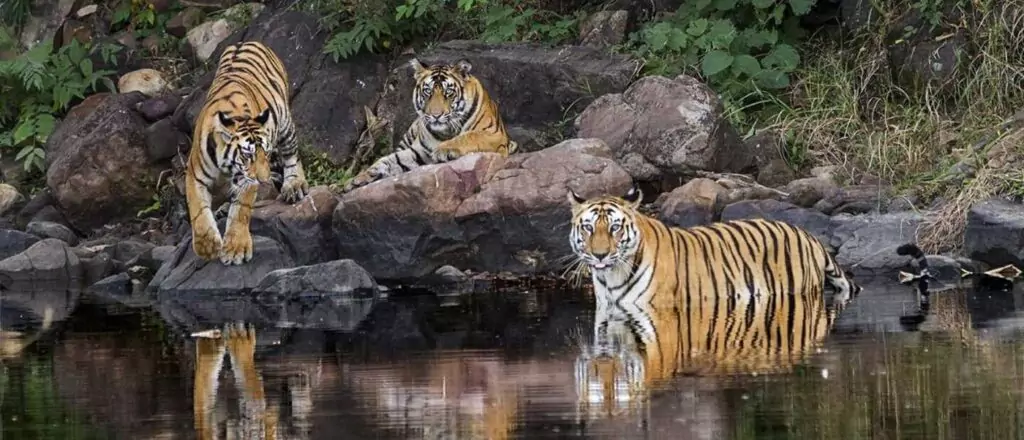
Published in a recent issue of Science, the study utilized extensive monitoring across 20 Indian states every four years to reveal not only the increase in tiger numbers but also the expansion of their protected habitats. Since 2006, there has been a 30% increase in the areas where tigers thrive. The findings indicate that tigers flourish in regions with higher economic development, where both locals and tourists support tiger tourism, and where governments provide compensation for any losses associated with tigers. On the other hand, less affluent states experience higher instances of human-tiger conflict, posing challenges for the survival of these magnificent creatures.
Coexisting with India’s growing population presents challenges for both humans and tigers, but the frequency of conflict may be lower than anticipated. “We lose 35 people to tiger attacks every year, 150 to leopards, and the same number to wild pigs. Additionally, 50,000 people die from snake bites,” shared Yadvendradev Vikramsinh Jhala, the study’s lead author, with the BBC. “In fact, within tiger reserves, you’re more likely to die from a car accident than from a tiger attack.”
The WWF has been a crucial player in the Tx2 initiative and recently published an article titled “5 Reasons for Hope for Tigers in 2025,” showcasing how tigers are naturally expanding into forests in northern Thailand, northeast China, and northern Myanmar. Furthermore, preparations are underway in Kazakhstan for the reintroduction of tigers in areas where they have been extinct for over a century. Excitingly, camera traps in Sumatra have recently recorded three times as many sightings of the Sumatran tiger subspecies, hinting at a positive trend for tiger populations globally.