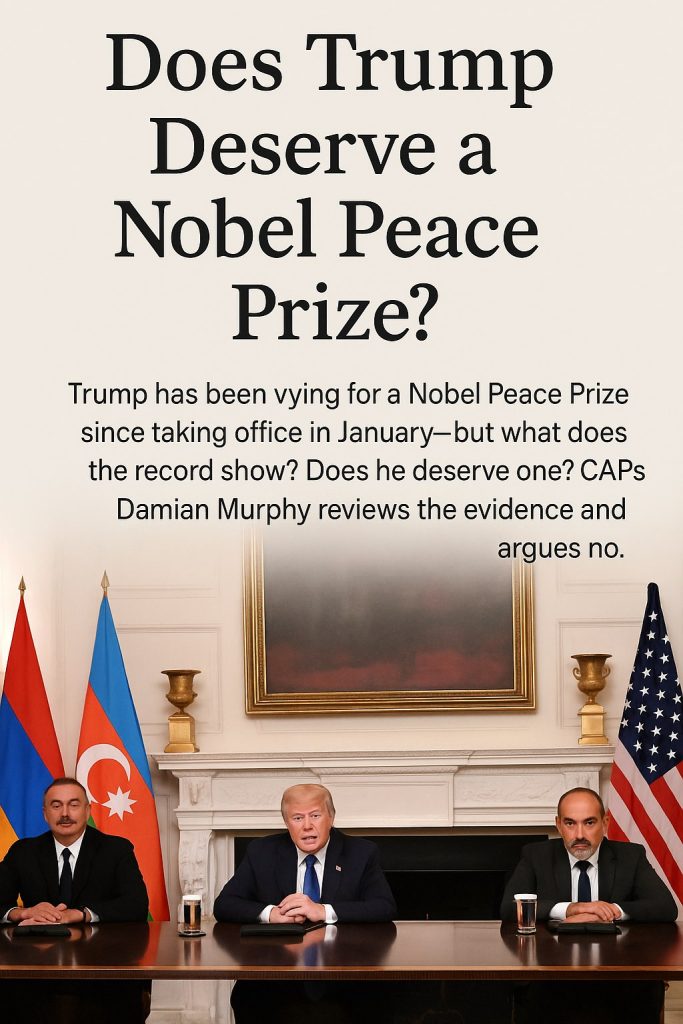
Since taking office in January, former President Donald Trump has made headlines not just for his policies, but for his unyielding pursuit of a Nobel Peace Prize. His supporters argue that a Nobel recognition would validate his achievements in diplomacy, while critics, including Center for American Progress’s (CAP) Damian Murphy, urge caution—questioning whether his presidency truly warrants such an honor.
Trump’s tenure has seen a whirlwind of controversial decisions and significant international events. From efforts to negotiate with North Korea to attempts to broker peace agreements in the Middle East, his actions have sparked much debate. However, as Murphy’s review of the evidence suggests, the record may not support the claim that Trump deserves a Nobel Peace Prize.
The argument surrounding Trump’s suitability for the award often centers on his dealings with North Korea. While he engaged in unprecedented direct diplomacy with Kim Jong-un, including historic summits, the tangible outcomes remain murky at best. Despite initial optimism, North Korea has continued its missile testing, and nuclear disarmament talks have stalled, leaving many to question the effectiveness of Trump’s approach.
Meanwhile, Trump’s administration heralded the Abraham Accords, which normalized relations between Israel and several Arab countries. While this development was a noteworthy diplomatic achievement, critics highlight that it did not resolve the longstanding Israeli-Palestinian conflict, which many believe should be central to any peace prize considerations.
Murphy’s analysis points to a broader pattern during Trump’s presidency—often characterized by more divisive rhetoric than conciliatory dialogue. It has been argued that his international dealings have sometimes undermined global cooperation, which is fundamental to peace efforts. His withdrawal from the Paris Agreement and the Iran nuclear deal are cited as actions that have, according to critics, fueled tensions rather than alleviating them.
Moreover, Trump’s approach to alliances, particularly his treatment of NATO and relationships with traditional allies, has raised concerns about America’s role in global stability. The notion that a single individual can claim a significant role in promoting peace while disassembling established alliances runs contrary to the collaborative spirit that the Nobel Peace Prize embodies.
Murphy concedes that proposing a leader for the Nobel Peace Prize is often contentious and subjective, hinging heavily on political ideology and personal beliefs. However, by examining the events of Trump’s presidency through an evidence-based lens, he argues that the case for his nomination lacks the substantial backing that would typically warrant such an esteemed recognition.
Ultimately, as the dialogue around Trump’s potential Nobel candidacy continues, it raises broader questions about the criteria used to assess candidates for such a prestigious honor. As the Nobel committee weighs nominees, it will have to consider not just political maneuvering, but the lasting impacts on global peace and cooperation.
Where to Learn More
- Trump’s Nobel Peace Prize Pursuit – ABC News
- Trump and the Nobel Prize: A Closer Look – CNN
- The Case Against Trump’s Nobel Peace Prize Nomination – The New York Times