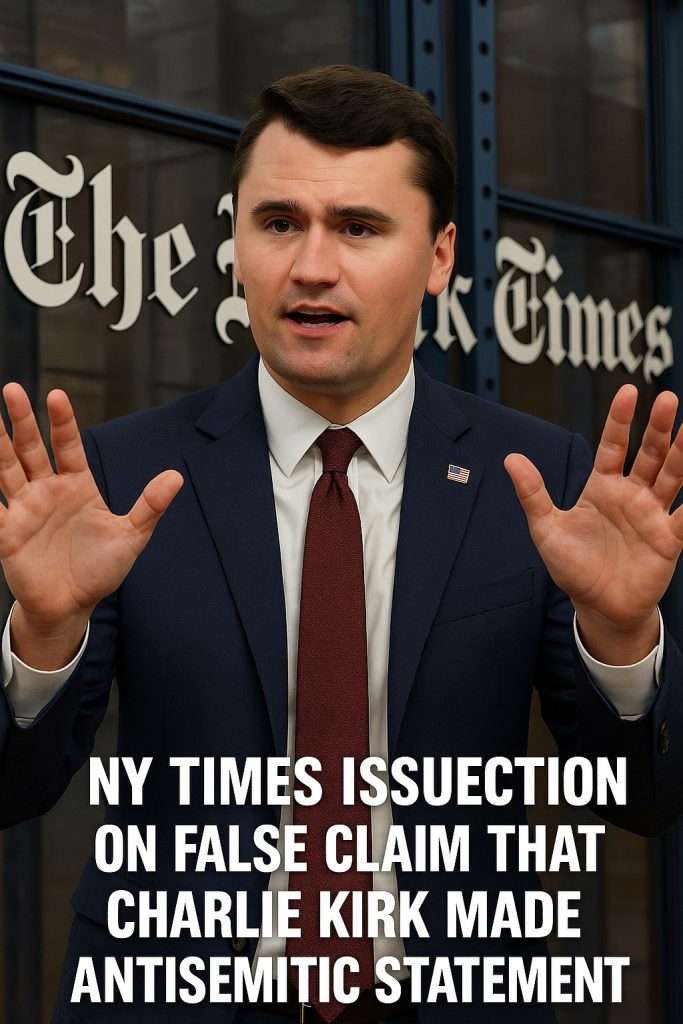
In a significant turn of events, The New York Times issued a correction on Thursday regarding a controversial claim that falsely attributed an antisemitic remark to the late Charlie Kirk, the founder of Turning Point USA. The correction highlights the importance of accuracy in reporting and the impact misinformation can have on public discourse.
The erroneous article suggested that Kirk had made an antisemitic statement during a critique of political discourse. However, upon further investigation, it became clear that he was actually critiquing the antisemitic remark itself, distancing his comments from any form of hate speech. The article, which initially went viral on social media, sparked outrage and debate regarding the current state of media accountability.
The misattribution has drawn criticism from various corners, including supporters of Kirk, who argue that such errors can have dire consequences, especially in a climate where antisemitism is an increasingly pressing issue. Critics have emphasized that responsible journalism must ensure that facts are verified rigorously before publication. The fallout from the initial report necessitated a deeper conversation on the reliability of sources and the responsibility of media outlets to correct their mistakes promptly.
In addition to addressing the error, The New York Times acknowledged that the misrepresentation prompted readers to question the veracity of their reporting, particularly regarding sensitive topics such as race and religion. As media consumers increasingly rely on social media to source their news, the stakes for accuracy could not be higher. Major social media platforms have been criticized for their role in spreading misinformation, further complicating the public’s ability to discern truth from falsehood.
Charlie Kirk, who was notable for his outspoken views as a conservative figure, has been a polarizing presence in American political discourse. Following the correction, reactions have poured in from both supporters and detractors. Supporters lauded the correction as a step towards accountability, while critics argue that such incidents only serve to highlight a pattern of inflammatory rhetoric that can be damaging to public dialogue.
Media analysts suggest that incidents like this serve as a reminder of the need for journalists to adhere to rigorous editorial standards. As misinformation continues to be a pressing concern, the role of fact-checking and the imperative for corrections in real-time becomes more crucial than ever. In an era defined by accelerated news cycles, ensuring accuracy over speed may well serve as a guiding principle for reputable journalism.
While The New York Times has made strides in addressing this matter, the larger narrative surrounding media trust and accountability remains. It is essential for consumers to remain discerning and informed about the origins of their news as the battleground for truth continues to evolve.
Where to Learn More
- The New York Times – Provides extensive reporting and analyses on major events, including corrections to previously published articles.
- BBC News – Offers a global perspective on current events, known for its commitment to accurate and impartial reporting.
- Associated Press – Renowned for its rigorous fact-checking and objective reportage of breaking news.
- NPR – Delivers in-depth coverage on a wide range of topics, including politics and social issues, while promoting media literacy.
- PolitiFact – Focuses specifically on fact-checking political claims and statements, providing clarification on contentious issues.