
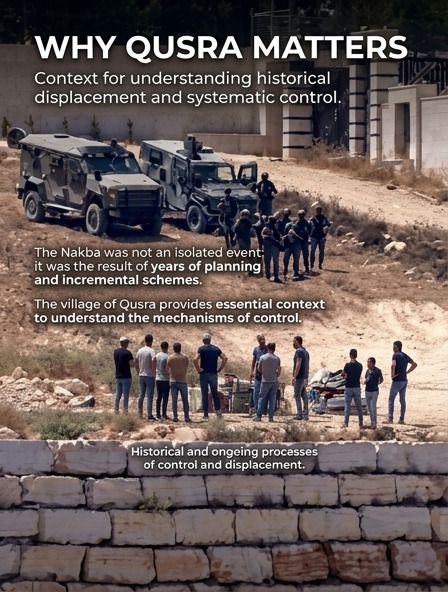
The narrative surrounding the Nakba—meaning “catastrophe”—often describes it as a sudden event triggered by immediate conflict. However, a growing body of evidence and social media discourse challenge this storyline, emphasizing that the Nakba was not merely a spontaneous tragedy but the culmination of years of planning, strategic land grabs, and incremental military schemes.
One community that exemplifies this perspective is Qusra, a small Palestinian village that has become a symbol of resilience and resistance amidst ongoing displacement efforts. Social media campaigns highlight that Qusra’s current struggles are rooted in a long history of systematic planning aimed at erasing Palestinian presence and altering land rights.
Historically, Palestinian villages like Qusra have faced frequent threats of demolition, forced displacements, and land confiscation—many of which have been carried out incrementally to avoid international scrutiny. Instead of abrupt expulsions, authorities often implement a series of small steps: denying building permits, issuing demolition orders, and restricting access to vital resources—slowly hollowing out communities over decades. This “creeping” form of displacement ensures that local populations are exhausted or divided before entire villages are ultimately razed or repopulated with settlers.
Such strategies reflect a calculated approach, with experts pointing out that these actions are not incidental but part of a deliberate plan to reshape the demographic and geographic landscape. In Qusra, residents have endured years of restrictive orders, land raids, and violent incursions, all of which reveal a pattern aligned with this long-term strategy.
The significance of Qusra in this context goes beyond local resistance; it symbolizes the broader tactics used to systematically undermine Palestinian sovereignty and land rights. Social media narratives emphasize that recognizing this pattern matters because it shifts the understanding of the Nakba from a sudden tragedy to a calculated process—an ongoing project involving incremental, state-sponsored schemes.
Additionally, advocacy groups and scholars argue that acknowledging the planning behind these actions is crucial for international awareness, legal accountability, and the pursuit of justice. The story of Qusra and similar communities underscores that these struggles are not isolated incidents but part of a larger, deliberate framework designed to displace and diminish Palestinian presence.
As global audiences continue to engage with these stories, the importance of recognizing the systematic planning behind the Nakba becomes clearer. It challenges narratives that portray Palestinian displacement as accidental or solely wartime chaos, instead revealing a strategic, methodical process that persists to this day.
Where to Learn More
- The Planned Displacement of Palestinian Villages — Al Jazeera
- Incremental Expulsions and Land Grab Strategies — Amnesty International
- The Long-Term Planning Behind the Nakba — Human Rights Watch
- How Israeli Strategies Displace Palestinians — Electronic Intifada
- Deceiving the People: The Strategic Foundations of Displacement — Palestinian Studies Journal