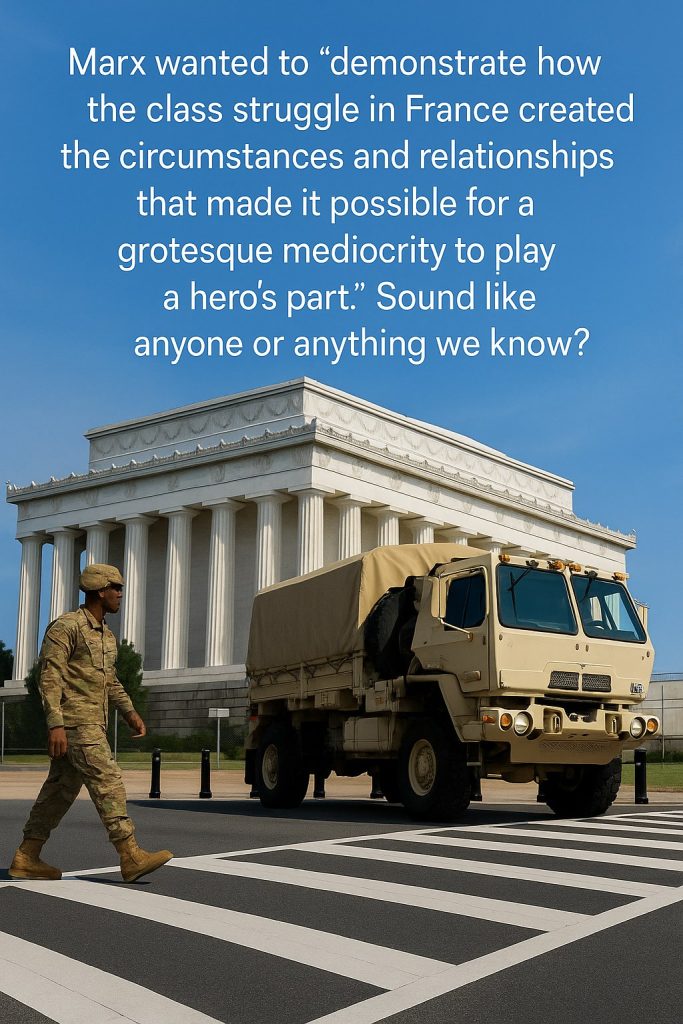
In a world increasingly perplexed by its leaders, the words of Karl Marx resonate with surprising relevance. Writing during the tumultuous political landscape of 19th-century France, Marx remarked on how the class struggle paved the way for “a grotesque mediocrity to play a hero’s part.” This idea, once confined to a historical context, now prompts fresh discussions about the characterization of modern political figures. In an era where charisma often outshines competence, many are left wondering: does this sentiment sound like anyone we know?
Marx’s assertion highlights the absurdities that emerge in political hierarchies, where individuals lacking substantial merit sometimes ascend to positions of power, captivating the masses not through substantive policy, but through spectacle. Fast forward to today, and the phenomenon seems alarmingly familiar. Observers of contemporary political culture have noted similar patterns—leaders who embody a blend of charm and mediocrity, often galvanizing public support in ways that defy traditional metrics of qualification.
Take, for example, certain high-profile figures who have made headlines not for their policies, but for their personality. Social media has enabled these leaders to construct their narratives, often presenting themselves as heroes fighting for the common man while sidestepping the nuanced complexities of governance. It is not just a matter of style over substance; it is about how cultural dynamics can elevate individuals who may not have the requisite experience or vision to enact meaningful change.
The modern digital landscape, where sensationalism often eclipses critical discourse, illustrates Marx’s theory in action. The internet, particularly platforms like Twitter and Instagram, fuels this phenomenon, allowing anyone with the right strategy to curate a heroic image. Just as 19th-century France grappled with its leaders during a time of upheaval, today’s society wrestles with similar challenges of representation and authenticity in governance.
Marx understood the role of social conditions in shaping leaders; he believed that class struggle and societal conflicts created an environment where certain figures could thrive despite their mediocrity. The question then becomes: are we actively participating in a system that rewards superficiality? In a climate where style often trumps substance, one must wonder about the implications for the future of leadership.
Critics of this trend argue that the glorification of mediocrity often leads to policies that are equally uninspired. The risk, they say, is clear: governance devolves into a popularity contest rather than a forum for rigorous debate about the issues that truly matter. Advocates for reform must call for a revival of authenticity, encouraging a political discourse that prioritizes informed leadership over charismatic appeal.
As Marx’s insights continue to echo in the corridors of power, the responsibility may lie with the electorate to discern substance from style. Engaging critically with our leaders, demanding accountability, and promoting candidates who embody real competence becomes paramount in restoring a healthy political process. In this light, the struggle against the grotesque mediocrity of leadership may not just reflect the challenges of the past, but also illuminate the path forward for a more engaged and informed citizenry.
Where to Learn More
- Class Struggles in France – Marxists Internet Archive
- Mediocre Leaders vs. Hero Leaders – The Atlantic
- How Social Media Engineered the Rise of Mediocre Leadership – Politico