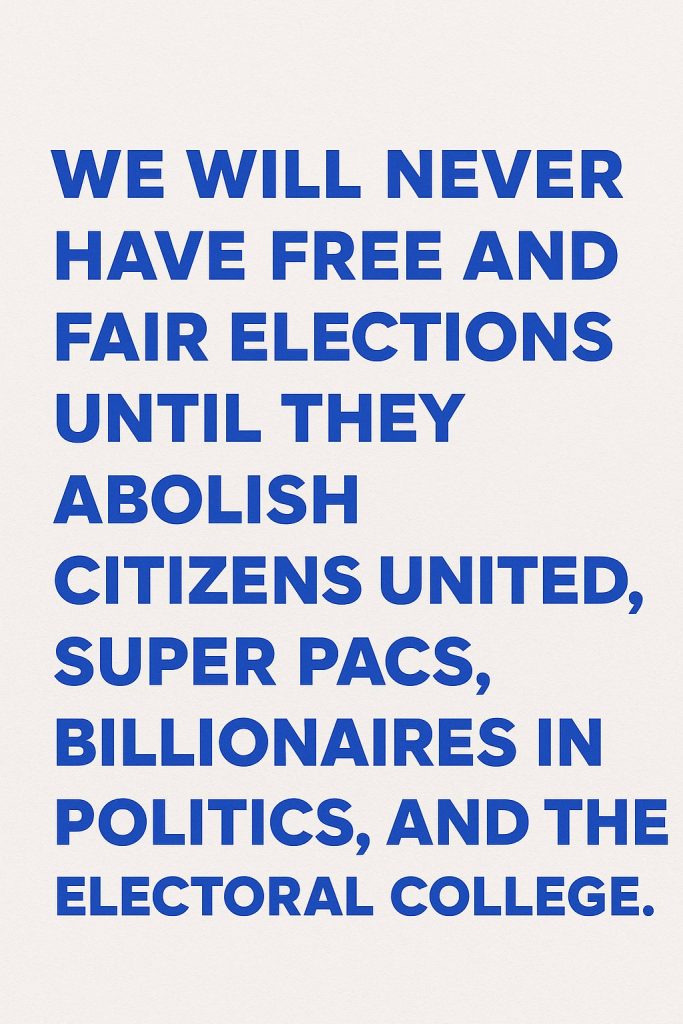
“We will never have free and fair elections until they abolish Citizens United, Super PACs, billionaires in politics, and the Electoral College.” This powerful message, recently spotlighted on social media, has ignited a nationwide conversation about the integrity of American democracy and the longstanding obstacles standing in the way of truly equitable elections.
The statement captures deep frustrations felt by many voters across the political spectrum. At the core of this debate lie four controversial pillars often cited as major contributors to electoral inequality: the Citizens United Supreme Court decision, Super PACs, the outsized influence of wealthy donors, and the Electoral College system.
In 2010, the landmark Citizens United v. Federal Election Commission ruling fundamentally changed the landscape of campaign finance. The Supreme Court held that corporations and unions have a First Amendment right to spend unlimited money on political campaigns, essentially equating political spending to free speech. Critics argue that this decision unleashed a flood of unregulated money into elections, empowering special interest groups and wealthy individuals while drowning out the voices of average voters.
Super PACs (Political Action Committees) emerged as a direct consequence of Citizens United. These organizations can raise and spend unlimited sums from corporations, unions, and individuals, provided they operate independently of candidates’ official campaigns. While proponents say Super PACs enhance political participation, opponents contend they allow billionaires and powerful entities to buy influence and distort democratic processes.
Indeed, the role of billionaires in politics has become a contentious topic, with numerous wealthy figures pouring vast fortunes into campaigns to sway elections, promote ideologies, or advance particular policies. The outsized power of these donors raises concerns about equity and representation, leading many to question whether elections truly reflect the will of the people or merely the interests of the richest.
Adding another layer of complexity is the Electoral College, a unique mechanism established by the U.S. Constitution. While designed as a buffer between the popular vote and the final presidential result, the Electoral College has been criticized for producing outcomes where a candidate wins the presidency without securing the popular vote, as seen in several recent elections. Detractors argue that the system disproportionately amplifies small states while marginalizing voting populations in larger states, further challenging the principle of “one person, one vote.”
The combined effect of these four elements raises fundamental questions: Can the United States genuinely claim to have a free and fair election system when such concentrated power and structural quirks influence outcomes? Will reforms be pursued to restore public trust and ensure equal representation?
Across the country, activists, political leaders, and ordinary citizens have called for sweeping changes, from overturning Citizens United through constitutional amendments to banning or severely restricting Super PACs, curbing the influence of billionaire donors, and even replacing the Electoral College with a national popular vote.
While these discussions are complex and politically charged, they reflect a growing awareness that the health of American democracy depends on elections that are open, transparent, and representative. The viral social media message resonates because it voices a collective yearning for fundamental reform — a democracy where every vote truly counts, and where money and arcane systems no longer dictate electoral outcomes.
Whether or not these reforms come to pass remains to be seen. However, the debate underscores the urgent need for informed public dialogue on how to safeguard free and fair elections in the 21st century.
Where to Learn More
- Citizens United v. FEC Decision – Supreme Court of the United States
- Super PACs Explained – OpenSecrets
- The Influence of Billionaires in American Politics – Brookings Institution
- How the Electoral College Works – U.S. National Archives
- FairVote: Advocating for Electoral Reform – FairVote