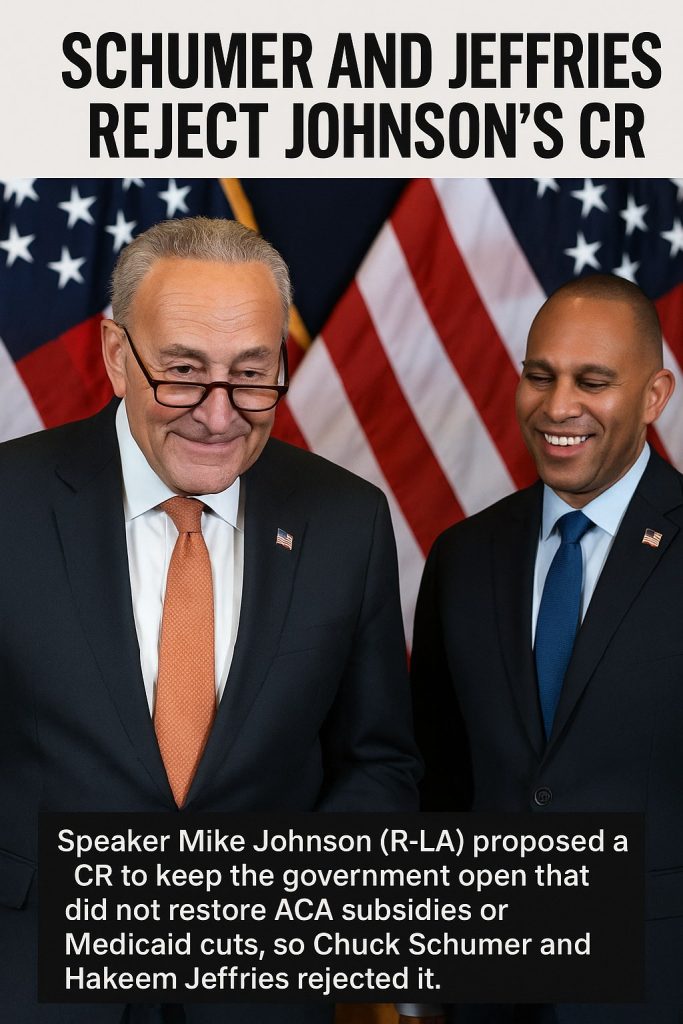
In a significant turn of events, Speaker Mike Johnson (R-LA) has proposed a continuing resolution (CR) aimed at preventing a government shutdown, but his plan has already ignited fierce backlash from Senate Democrats. The proposal, which notably fails to restore Affordable Care Act (ACA) subsidies and maintains cuts to Medicaid, was swiftly rejected by Senate Majority Leader Chuck Schumer and House Minority Leader Hakeem Jeffries, setting the stage for a potential political showdown.
The urgency surrounding the proposed CR stems from the impending deadline for government funding, which is just days away. Johnson’s plan is seen by some as a strategic move to leverage political negotiations in favor of Republican priorities, particularly in light of budgetary pressures that could lead to massive disruptions in federal services. However, the exclusion of crucial healthcare funding provisions has drawn ire from the opposition, making bipartisan cooperation increasingly elusive.
“This proposal falls short of the bipartisan compromise necessary to ensure our public health safety nets remain funded,” Schumer stated in a press conference following the proposal’s unveiling. Schumer’s remarks reflect a growing frustration among Democrats who are worried about the implications of continued Medicaid cuts, especially as many Americans still grapple with the economic fallout from the pandemic.
Similarly, Jeffries echoed this sentiment, labeling the proposal “irresponsible” and “shortsighted.” He underscored the importance of restoring ACA subsidies, which are critical for millions of Americans who depend on these services for their healthcare needs. “We cannot allow partisanship to dictate the welfare of the American people,” Jeffries emphasized, signaling that Democrats would not support any budget that undermines healthcare access.
As lawmakers rush to negotiate a viable budget solution, the stakes are high. Failure to pass a CR could lead to a government shutdown, disrupting essential services and impacting millions whose livelihoods depend on federal programs. The conflict also illustrates the broader trend of increasing polarization in Congress, with each party digging in its heels over key issues, further complicating negotiations.
Political analysts suggest that the rejection of Johnson’s proposal may force the Speaker to reconsider the elements of his CR if he hopes to secure any measure of bipartisan support. “The clock is ticking, and both sides need to come to the table sooner rather than later,” noted political strategist Laura K. Martin. “The American public is fatigued by political games, and with mounting pressure, compromise may become inevitable.”
As the debate unfolds, many are looking to new leadership and strategies within both parties to find common ground. Negotiations are expected to intensify in the coming days, with healthcare funding remaining at the forefront of discussions. Johnson’s next moves will be critical in determining whether a deal can be reached before the looming deadline.
In the face of rising tensions, one thing remains clear: how Congress navigates this budgetary challenge could have lasting implications for healthcare accessibility, political relationships, and public trust moving forward.
Where to Learn More
- Government Shutdown Looms as Republicans and Democrats Clash Over Budget – The New York Times
- Johnson’s CR Proposal Sparks Fury Among Democrats – Politico
- Congress Faces Unprecedented Deadlock as Shutdown Deadline Approaches – The Washington Post
- Healthcare Funding Takes Center Stage in Budget Talks – CNN