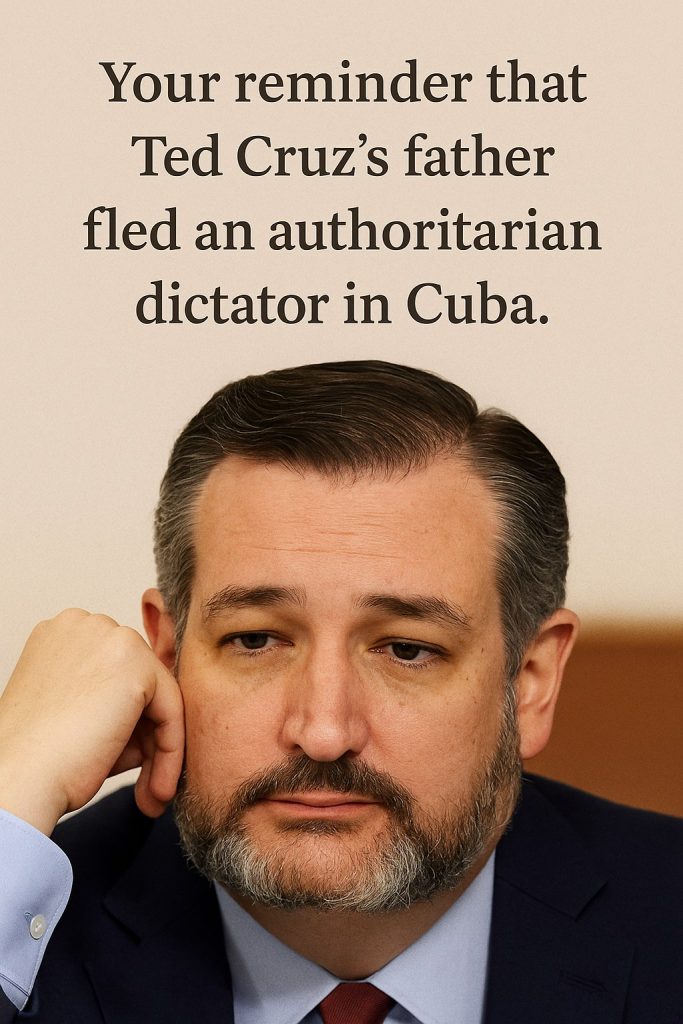
In a striking image that has captured the attention of social media users, a reminder of the complex legacy of Senator Ted Cruz has resurfaced, igniting discussions around authoritarianism and political fidelity. The image features a poignant message: “Your reminder that Ted Cruz’s father fled an authoritarian dictator in Cuba. Only to have his son enable an authoritarian dictator in America.” This provocative statement has fed into a wider narrative about Cruz’s political actions in relation to his family’s immigrant history.
Rafael Cruz, Ted Cruz’s father, fled the oppressive regime of Fidel Castro in 1957, seeking freedom and opportunity in the United States. His journey is often highlighted by supporters who point to it as a testament to the American dream and the values of liberty. However, critics have increasingly contended that the senator’s political maneuvers over the years contradict those values. Suggestions that Cruz has supported authoritarian tendencies, particularly during the Trump administration, have garnered substantial attention, forming the crux of social media dialogues.
Many argue that Cruz’s loyalty to former President Donald Trump, a figure some deem as a populist authoritarian, showcases a disturbing paradox. While Cruz’s father escaped an autocratic regime, critics fear that his son’s actions align closely with enabling similar tendencies closer to home. This juxtaposition of Cruz’s personal history against his political choices raises questions about the interpretations of freedom and democracy both in the United States and in the world at large.
Social media platforms have acted as a battleground for these ideas, with left-leaning users emphasizing the irony of Cruz’s alignment with Trump. The viral post has sparked considerable debate around the responsibility of public figures to uphold democratic values, especially those whose very existence in the United States is contingent upon fleeing authoritarianism.
Moreover, in a time when political polarization is at an all-time high, this narrative has found its way into broader discussions about immigration, loyalty, and the responsibilities of those in power. Supporters of Cruz argue that his policies are rooted in a desire to protect American interests, while detractors claim he has compromised his principles for political expediency. This clash is not just political; it’s deeply personal for many, particularly those whose families have also escaped from oppressive regimes.
The resurfacing of this image has not only reignited discussions about Cruz but also serves as a reminder of the historical patterns of political behavior that can overshadow personal histories. As the political climate becomes increasingly tumultuous, the reminder of Ted Cruz’s father fleeing Castro may resonate more profoundly than intended, prompting a new wave of scrutiny over how personal history influences public duty on the political stage.
Where to Learn More
- Ted Cruz, a GOP Hero for the Far Right, Is Under Pressure Over Capitol Riot – The New York Times
- Ted Cruz faces backlash and opportunities in 2022 midterms – The Washington Post
- Ted Cruz plots a path for reelection in 2024 – Politico


