
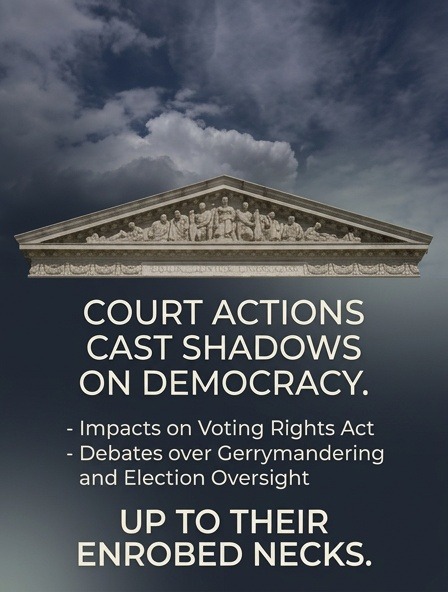
In what civil rights advocates are calling a startling blow to American democracy, the Supreme Court’s recent decisions have effectively dismantled key protections designed to ensure fair elections. By neutering the Voting Rights Act, encouraging partisan gerrymandering, and relaxing oversight of the Federal Election Assistance Commission (EAC), the court appears to be actively setting the stage for a more rigged electoral process ahead of the upcoming elections.
The Voting Rights Act of 1965, once the cornerstone of protections against racial discrimination in voting, has suffered significant setbacks in recent years. The court’s rulings have weakened this vital legislation, making it easier for states to implement voting restrictions—such as stringent ID laws, poll closures, and discrimination against minority voters—without fear of federal intervention. Critics warn that these measures disproportionately suppress turnout among marginalized communities, skewing election results and undermining the democratic principle of one person, one vote.
Adding fuel to the fire is the court’s encouragement of partisan gerrymandering. In multiple rulings, the judiciary has signaled its reluctance to curb the practice of drawing electoral districts to favor one political party over another. This strategy significantly impacts electoral competitiveness, allowing politicians to entrench themselves in power regardless of voting outcomes. As districts become gerrymandered, the voice of everyday voters diminishes, and elections move further from representing the true will of the people.
Perhaps most troubling is the Supreme Court’s decision to free the Trump administration to gut the Federal Election Assistance Commission. The EAC plays a vital role in coordinating federal election procedures and providing resources and guidance to states. Its effective dismantling could lead to inconsistencies in election administration, reduced election security, and diminished support for voting infrastructure—further sowing chaos and distrust among voters.
These combined actions raise serious concerns about the integrity and fairness of the upcoming elections. Critics argue that the court, often seen as an impartial arbiter, is now enrobed in a way that favors partisan and anti-democratic agendas. With the electoral landscape increasingly weaponized, many worry that this year’s elections could be marred by suppressed ballots, manipulated districts, and reduced voting protections—ultimately threatening the foundational principles of American democracy.
As citizens and advocacy groups mobilize against these moves, questions abound about the future of voting rights and election integrity in the United States. Experts emphasize that active judicial engagement is crucial to safeguard democratic processes from being overshadowed by strategic legal rulings aimed at consolidating partisan power.
Where to Learn More
- How Recent Court Rulings Are Weakening the Voting Rights Act – NPR
- The Rise of Gerrymandering and the Court’s Role in Electoral Manipulation – The Washington Post
- Electoral Reform Failures and the Future of Fair Elections – Brennan Center for Justice
- The Impact of Court Decisions on Election Security and Integrity – The New York Times