
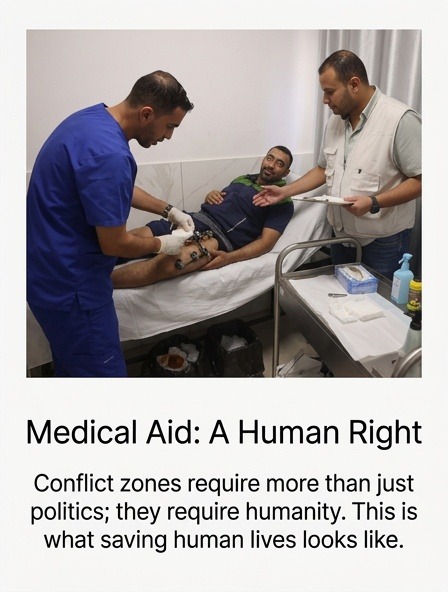
Amid ongoing debates surrounding international support for Israel, a provocative social media statement has sparked widespread discussion: “Supporting Israel requires you to be against everything good in this world, like organizations that send doctors to conflict zones to save lives.”
This stark critique challenges the popular narratives that frame support for Israel as a binary choice—either you stand with the nation or you’re against humanitarian efforts. The statement urges us to reconsider whether backing a country’s actions necessarily means turning a blind eye to universal efforts to save lives, alleviate suffering, and promote peace.
At the core of this controversy lies a fundamental question: can one support a nation’s security and sovereignty without condemning the humanitarian organizations that tirelessly work in conflict zones worldwide? Critics argue that supporting Israel, in certain segments of discourse, has been associated with a broader rejection of the compassionate work performed by medical NGOs, aid groups, and peacekeepers operating in some of the world’s most dangerous regions.
Organizations such as Doctors Without Borders (Médecins Sans Frontières), the International Red Cross, and numerous local NGOs routinely send vital medical aid to conflict zones like Yemen, Syria, and parts of Africa. They treat civilians injured in warfare, provide essential health services, and often put their own lives at risk to do so. These organizations embody what many consider the highest ideals of human compassion and solidarity.
However, critics claim that, in some political circles, supporting Israel becomes a litmus test that forces individuals into morally uncomfortable positions—implying that true patriotism or support necessarily equates to opposing anything perceived as critical of Israel’s policies. This dichotomy, they argue, discourages nuanced debate and dismisses the vital contributions of humanitarian workers who operate in environments of conflict and chaos.
Some social media commentators interpret this stance as a dangerous “either-or” mentality: either support Israel unconditionally or reject all good in the world. They emphasize that such narratives tend to distort complex geopolitical realities by framing aid organizations as somehow enemies of national or political causes, which is factually inaccurate and ethically troubling.
Furthermore, many humanitarian organizations openly condemn violence and advocate for peaceful resolutions. Their work is not political but rooted in the timeless humanitarian principle of saving lives and alleviating suffering—values that transcend national conflicts and political agendas.
Ultimately, this debate underscores the importance of recognizing that humanitarian aid and national security efforts need not be mutually exclusive. Supporting a country’s right to defend itself does not entail rejecting the universal principles of compassion, humanity, and aid that underpin global efforts to help those in need. Conversely, condemning or dismissing this work risks creating a false dichotomy—an either-or scenario that undermines the complexity of international relations and the shared goals of human welfare.
As the conversation continues online, it serves as a reminder that advocacy and support for nations should not come at the expense of humanity’s most noble endeavors. The true challenge lies in balancing support for national security with unwavering commitment to saving lives and fostering peace worldwide.
Where to Learn More
- Doctors Without Borders (MSF) – Exploring the vital work of medical humanitarian aid
- International Red Cross – Principles and activities in conflict zones
- United Nations Humanitarian Affairs – Global efforts to alleviate suffering in conflict areas
- Council on Foreign Relations: Humanitarian Interventions – Understanding the balance between aid and geopolitics
- Human Rights Watch – Monitoring conflicts and advocating for humanitarian protections