
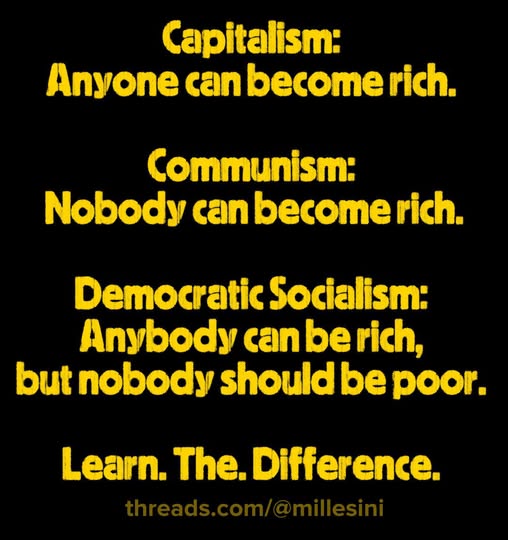
A recent viral social media post has generated widespread discussion and laughter by illustrating the contrasting narratives behind different economic systems through a clever, humorous graphic. The post features a simple yet thought-provoking text image that summarizes the core principles of capitalism, communism, and democratic socialism in a succinct and witty manner.
The graphic reads: “Capitalism: Anyone can become rich. Communism: Nobody can become rich. Democratic Socialism: Anybody can be rich, but nobody should be shouldbepoor.” This clever twist on economic ideologies captures the essence—and the criticisms—of each system with humor and simplicity, making complex ideas accessible to a broad online audience.
At its core, the post highlights the ongoing debates about economic opportunity, wealth distribution, and social equity. Critics of capitalism often point out that while it promises individual success, it can also lead to significant inequality, making the idea of “anyone can become rich” feel disconnected from reality for many. Conversely, proponents of communism emphasize equality and the abolition of class distinctions, but critics argue that it stifles personal initiative and economic mobility, hence the phrase “nobody can become rich.”
Democratic socialism, as portrayed in the graphic, advocates for a middle ground—where equal opportunity exists, but social safety nets and public services prevent people from falling into poverty. The line “Anybody can be rich, but nobody should be shouldbepoor” encapsulates the goal of many such systems: fostering prosperity without sacrificing fairness or social justice.
Social media users have reacted with both humor and reflection. Many appreciate the succinct critique of economic systems, while others see it as a satirical reminder of the complexities involved. The post has sparked a series of discussions across platforms, inviting followers to examine the realities behind these simplified descriptions and consider how different policies impact societies worldwide.
Experts note that such viral graphics serve as entry points for broader conversations about economic policy and social priorities. As debates about wealth inequality, social mobility, and economic reform continue globally, this humorous take captures the imagination while encouraging viewers to learn more about the nuances behind each ideology.
In an era where information and misinformation collide, clear and engaging content like this helps foster understanding and critical thinking. Whether you agree or disagree with the caricature, it undeniably succeeds at opening dialogue on important issues shaping our world today.