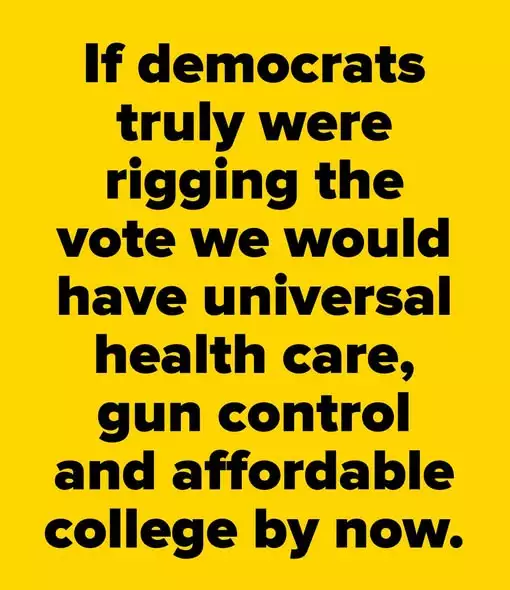
In the rapidly circulating social media post that’s capturing attention across platforms, a simple yet provocative message reads: “If Democrats truly were rigging the vote, we would have universal health care, gun control and affordable college by now.” This stark statement has ignited a fiery debate among users, politicians, and political analysts about the realities of policy legislation, electoral influence, and what it truly means to “rig” an election.
The message implies that if the Democratic Party truly controlled electoral outcomes through malfeasance or corruption, the party would have achieved certain progressive policy goals—namely universal health care, stricter gun control laws, and affordable higher education—by now. The underlying message questions whether the current political gridlock is a result of voter suppression or election rigging, or if other factors are at play.
Experts point out that U.S. political gridlock is a complex issue influenced by numerous factors, including the Electoral College system, gerrymandering, campaign financing, partisan polarization, and legislative filibusters. While accusations of election rigging have increased in recent years, credible evidence supporting widespread voter fraud remains limited, according to multiple elections oversight agencies and studies.
Democratic policies have faced numerous hurdles, even when elected officials support progressive legislation. For example, efforts to implement universal health care have consistently met resistance in Congress, often due to opposition from Republican lawmakers and the influence of lobbyists representing the healthcare industry. Similarly, gun control initiatives, despite significant public support, struggle to pass in many states due to political opposition and the power of the gun lobby. And affordability of college remains a challenge, in part because of rising tuition costs and policies influenced by various economic interests.
Some critics suggest that the social media post oversimplifies a nuanced political landscape, where the obstacles to progressive policies are not solely linked to election rigging but also to deeply entrenched partisan divides and economic interests. Others argue that the framing serves as a reminder that systemic issues in American democracy can undermine voters’ will, whether through structural barriers or political inertia.
It’s important for voters to critically evaluate claims about election integrity and policy failure. While concerns about election security are legitimate and have prompted reforms in some areas, sweeping accusations require concrete evidence rather than soundbites or memes.
Ultimately, engaging in informed discussions about how policies are made and the factors obstructing progress can foster a healthier democratic process. Recognizing the complexity of policy implementation and electoral dynamics is essential in understanding why certain legislative goals remain elusive, regardless of which party holds power.
Where to Learn More
- Electoral Justice and Electoral Integrity – Brennan Center for Justice
- The Truth About Voter Fraud Claims – CNN
- How Elections Are Changing in America – Pew Research Center
- Why Does Legislation Get Stuck in Congress? – NPR