
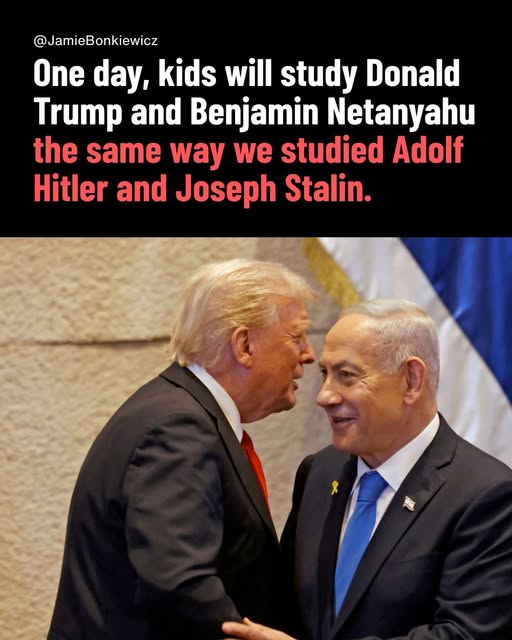
Social media users are increasingly engaging in provocative and thought-provoking discussions about the future of global leadership and historical memory. A viral post by @JamieBonkiewicz has gained widespread attention after stating, “One day, kids will study Donald Trump and Benjamin Netanyahu the same way we studied Adolf Hitler and Joseph Stalin.” This bold comparison has sparked intense debates across platforms, raising questions about the legacy of two of today’s most influential and controversial leaders.
The post underscores a growing sentiment among some observers that figures such as Donald Trump, the former U.S. President, and Benjamin Netanyahu, Israel’s long-serving Prime Minister, embody complex political legacies that could be scrutinized and studied in historical contexts similar to infamous 20th-century dictators and authoritarian rulers. While the comparison is provocative, it prompts a broader reflection on how history judges political figures whose actions, policies, and rhetoric leave deep impacts—and often polarize public opinion.
Historically, figures like Hitler and Stalin have been studied extensively due to their roles in shaping world history, their devastating policies, and the atrocities committed during their regimes. Their names have become synonymous with tyranny and human suffering, serving as cautionary examples in history education worldwide. The post implies that, in the future, leaders like Trump and Netanyahu may be similarly analyzed—a reflection of their enduring influence and the polarized perceptions surrounding them.
Some critics argue that the comparison is hyperbolic or overly simplistic, given the vastly different contexts and actions of these leaders. Others contend that the post highlights how societal perceptions evolve, and how history may judge contemporary figures in ways that are still unfolding. The proliferation of social media has amplified these debates, as users project into the future and examine current events through the lens of history.
This conversation resonates in a world where political rhetoric, national security, and democracy are under intense scrutiny. As new generations rise and historical narratives are reassessed, the way future scholars interpret the legacies of Trump and Netanyahu could shape understanding of the 21st century’s geopolitical landscape. The post invites us to reflect on how we remember leaders today and the enduring significance of their influence on future generations.
Whether one agrees or disagrees with the comparison, the underlying message is clear: history’s judgment is complicated, multifaceted, and often still evolving. The viral comment serves as a reminder that leaders are ultimately judged by their legacy—and that future generations may view today’s political giants through a completely different lens than we do now.
Where to Learn More
- How Historians Might View Donald Trump Five Decades From Now – BBC
- The Future of Political Legacy: Trump, Netanyahu, and Historical Memory – The New York Times
- Adolf Hitler: The Rise of a Dictator – History.com
- Joseph Stalin: A Legacy of Power and Control – St. Louis Magazine