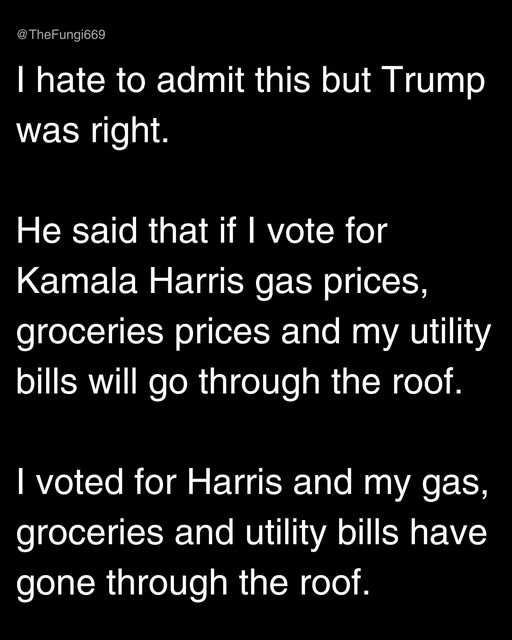
A provocative social media post has recently gained widespread attention, with a user claiming that voting for Vice President Kamala Harris — viewed by some as a potential future president — has directly led to increases in gas prices, grocery bills, and utility costs. The post, which features an image with the quote “@@TheFungi669 I hate to admit this but Trump was right. He said that if I vote for Kamala Harris gas prices, groceries prices and my utility bills will go through the roof,” has sparked a flurry of discussion and controversy across platforms like Twitter and Facebook.
While the statement is undeniably provocative, it reflects a broader mood of frustration among many Americans facing rising costs amidst ongoing economic challenges. Over the past year, inflation has impacted various sectors, with energy prices, food costs, and utility bills climbing steadily. This has led some to seek accountability and explanations from policymakers.
Critics on social media have debated whether the post accurately attributes inflation or cost hikes directly to the policies of the Biden-Harris administration or if other factors are at play. Experts acknowledge that inflation is a complex phenomenon influenced by global supply chain disruptions, geopolitical tensions, and energy market dynamics. However, political rhetoric often simplifies these issues by pointing fingers at contemporary leadership.
The original poster’s sentiment also underscores the deep polarization currently dividing American voters, with some expressing certainty that recent economic woes are a direct result of current administration policies, while others argue that blame oversimplifies a multifaceted issue.
Economic analysts note that gas prices, in particular, are heavily influenced by global oil markets, OPEC decisions, and energy policies that stretch across administrations. Similarly, food and utility prices are affected by supply chain issues, weather events, and energy costs. Therefore, attributing all inflationary pressures solely to one administration or a single politician may overlook the complexity of economic forces at play.
This social media post encapsulates the volatile political climate and the challenge for voters to sift through rhetoric to find accurate information. As the 2024 elections approach, debates over economic management are expected to intensify, with candidates and their supporters making contrasting claims about who is responsible for the current state of America’s economy.
For now, the post serves as a reminder of how social media amplifies opinions — sometimes oversimplifying issues that require nuanced understanding. Whether one agrees or disagrees, it highlights the importance of examining data and multiple perspectives before drawing conclusions about economic policies or political leadership.