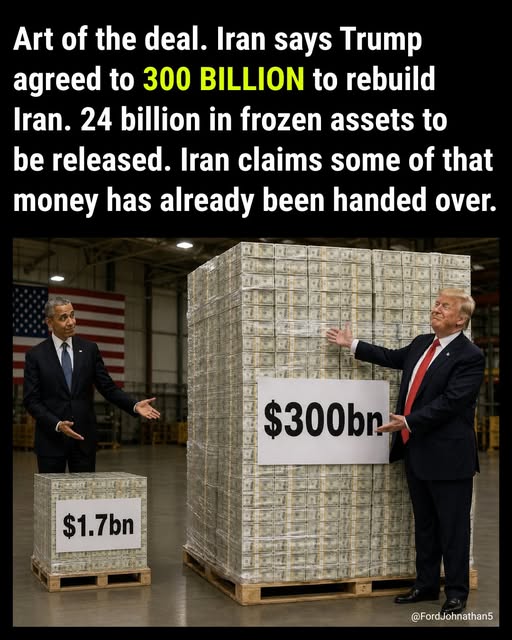
In a startling social media viral post, claims have emerged suggesting a secret diplomatic deal between former U.S. President Donald Trump and Iran. According to widely circulated images and messages, Iran alleges that Trump agreed to an astonishing sum of $300 billion to aid in Iran’s reconstruction efforts. The post also indicates that around $24 billion in Iranian assets, previously frozen by U.S. sanctions, could be slated for release—although Iran contends that only part of that amount has been returned so far.
The social media storm hinges on an alleged “Art of the Deal,” suggesting a covert understanding that could reshape regional dynamics. The images show stacks of money alongside text implying this significant financial agreement. While these claims have yet to be officially confirmed, they have ignited intense speculation among analysts, policymakers, and the general public, particularly given the complex history of U.S.-Iran relations.
Historically, U.S. sanctions have frozen over $100 billion in Iranian assets abroad, primarily in countries like South Korea, Japan, and the United Arab Emirates. These sanctions, enforced during the Trump administration and earlier, significantly hampered Iran’s economy, especially its oil exports. Iran has long demanded the unfreezing of these assets, emphasizing that their release could be vital for stabilizing its economy and funding reconstruction projects.
The claim that Trump agreed to release $24 billion aligns with Iran’s longstanding demands, but the purported figure of $300 billion to rebuild Iran raises skepticism among experts. Neither the U.S. government nor credible sources have officially acknowledged such a deal. Diplomats and analysts caution that social media posts—especially without verified evidence—should be taken with caution. Nonetheless, the posts have gone viral, fueling speculation about behind-the-scenes negotiations that may be happening or have transpired.
It is important to note that diplomatic relationships are often complex, involving multiple clandestine channels and negotiations that are not always publicly disclosed. If such an agreement were real, it could mark a significant shift in U.S.-Iran relations, potentially leading to a thaw in longstanding sanctions and economic hardship.
However, critics warn that unsubstantiated claims on social media can also be used to manipulate public opinion or obscure diplomatic realities. Until official sources confirm or deny these reports, they remain part of the broader debate on possible future paths for U.S.-Iran diplomacy.
As conversations continue online and in diplomatic circles, experts advise caution and underscore the necessity of thorough verification before drawing conclusions about such impactful claims.