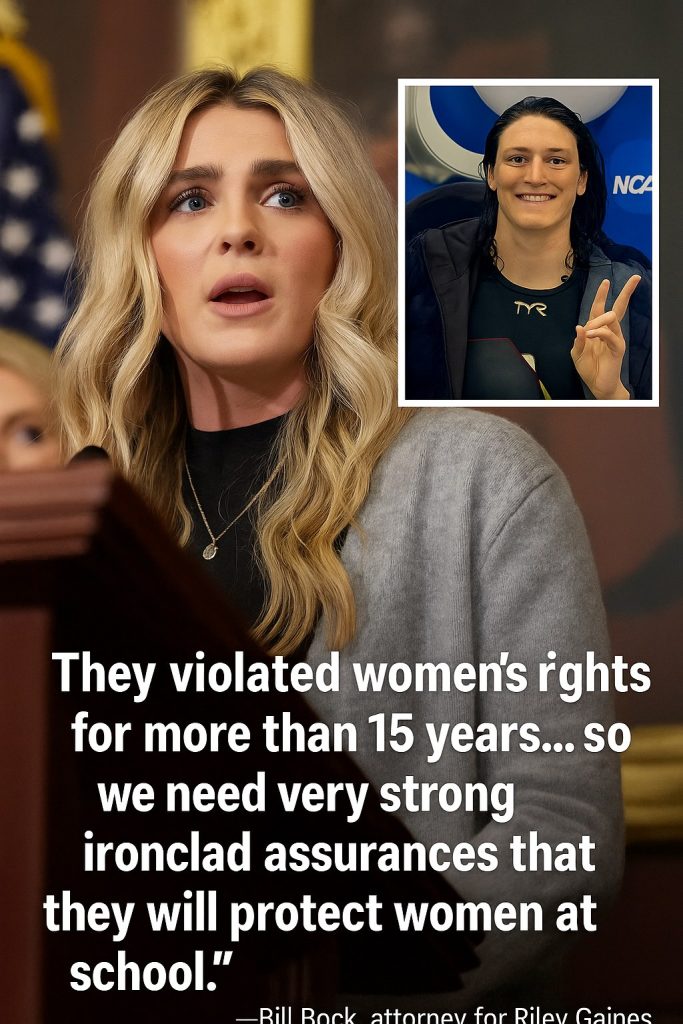
In a significant development in the ongoing legal battle over transgender athletes in women’s sports, a federal judge has ruled that Riley Gaines’ lawsuit against the NCAA can continue. This ruling comes amidst rising tensions in the national debate over gender identity in athletics, with many supporters rallying behind Gaines and her fight for what she asserts are violations of women’s rights.
Riley Gaines, a former NCAA swimmer with multiple accolades, has become a prominent figure advocating for women’s sports since competing against transgender swimmer Lia Thomas. Thomas, who was born male, swam for the University of Pennsylvania and garnered extensive media attention after winning the NCAA championship in the women’s 500-yard freestyle event in 2022. Following this experience, Gaines has argued that allowing transgender women to compete in women’s sports undermines the integrity of female athletics and endangers their rights.
Gaines’ lawsuit, filed in 2022, seeks to hold the NCAA accountable for what she describes as a “violation” of Title IX protections, which were designed to ensure equitable treatment in education and sports for women. The ruling by the federal judge to allow the lawsuit to move forward has energized those who support Gaines’ cause, igniting discussions surrounding athletes’ rights and inclusivity.
Her attorney has hinted at the possibility of a settlement, although he acknowledged that reaching an agreement would be “difficult.” “While all parties have expressed a desire to resolve this matter, it is crucial that any agreement includes strong ironclad assurances that protect the rights of female athletes,” he stated during a recent press conference. This indicates that while the wheels of justice continue to turn, a satisfactory resolution is complicated by the deeply entrenched positions on both sides of the debate.
In recent years, the NCAA has faced intense scrutiny for its policies on transgender athletes, which have varied and evolved as public opinion and legislation shift. The governing body has stated its commitment to providing an inclusive environment for all athletes, but critics have argued that these policies often come at the expense of fair competition for women. The conversation has only intensified with several states enacting laws designed to ban transgender athletes from participating in sports that align with their gender identity, leading to a fragmented national discourse.
For Gaines and her supporters, the lawsuit represents more than a legal claim; it is a stand against what she sees as long-standing injustices inflicted upon female athletes. In her public statements, she has asserted, “They violated women’s rights for more than 15 years… so we need very strong ironclad assurances that they will protect our rights going forward.”
The ruling and the possibility of settlement have caught the attention of various factions across the country, from grassroots activists to high-profile commentators. As the legal process unfolds, many will be watching closely to see how it will influence not just collegiate sports, but also legislation and the broader conversation on gender identity in sports.