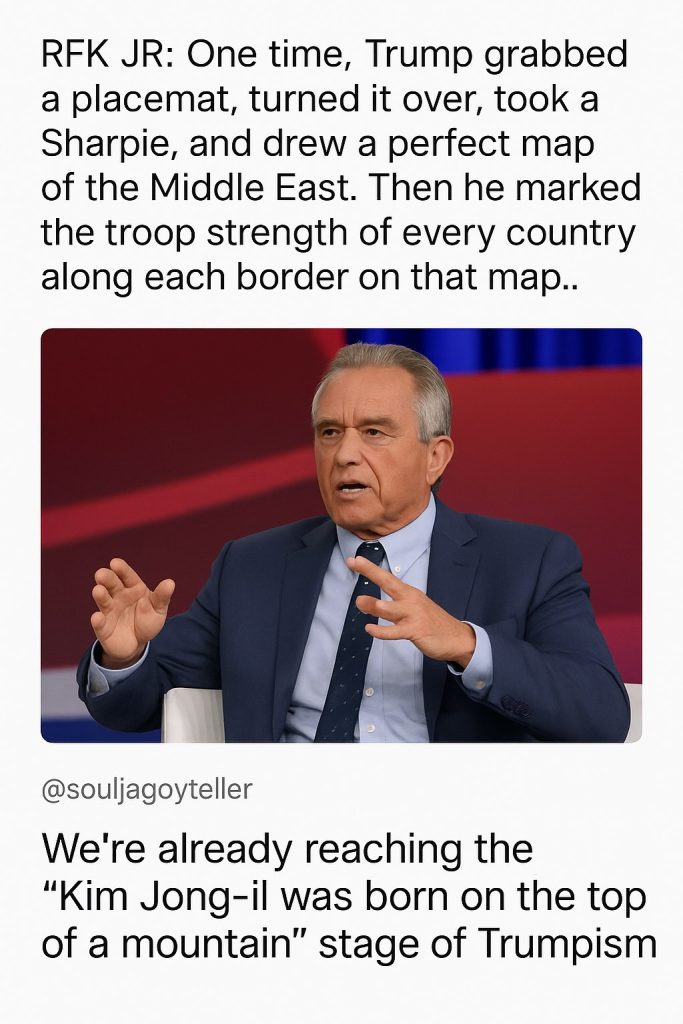
In an unexpected and captivating anecdote, Robert F. Kennedy Jr. recently recounted a striking moment that highlights former President Donald Trump’s surprising grasp of Middle East geopolitics. During a social media conversation that quickly went viral, RFK Jr. described an incident where Trump, armed only with a placemat and a Sharpie marker, proceeded to draw a detailed, near-perfect map of the Middle East, all while specifying U.S. troop strengths in the region.
This story, shared by RFK Jr., has captivated social media users for its vivid portrayal of Trump’s seemingly intimate knowledge of complex military deployments — an attribute not often emphasized in mainstream discourse surrounding the former president’s approach to foreign policy.
“One time, Trump grabbed a placemat, turned it over, took a Sharpie, and drew a perfect map of the Middle East,” RFK Jr. said during a conversation that has since been widely circulated online. “Then he marked the troop strength of every country where US military personnel are stationed,” he added, emphasizing the precision and detail Trump exhibited.
While Trump’s foreign policy decisions, often characterized by a mix of unconventional approaches and nationalist rhetoric, have been the subject of extensive analysis, this story suggests a more hands-on and informed side of his engagement with international military strategy.
This visual and tactile display of knowledge hints at an alternative narrative — one that views Trump not just as a political outsider and populist but as someone capable of detailed strategic thinking in volatile regions. It also raises questions about the role of informal moments and personal intuition in shaping policies that impact global security.
Experts in Middle Eastern affairs and military strategy are divided in their interpretation of Trump’s actual effectiveness and understanding. Critics argue that Trump’s administration at times adopted policies that sowed confusion, such as the abrupt withdrawal from northern Syria, which altered geopolitical alliances overnight.
Supporters, however, point to Trump’s willingness to be hands-on and directly involved in military matters, citing such anecdotes as evidence of his active engagement and unconventional style — sometimes relying on instinct as much as formal intelligence briefings.
The viral story also reflects how personalities and personal moments can humanize or complicate public figures’ images beyond policy headlines and political rhetoric. As social media continues to shape political narratives, these glimpses into behind-the-scenes behavior hold power to influence public perception.
Regardless of political leanings, RFK Jr.’s vivid account offers a fascinating glimpse into the unusual ways in which a former president engaged with one of the most complex regions in the world — the Middle East — highlighting the intricate interplay between personality, power, and policy.
As this anecdote circulates, it invites renewed discussion on the nature of leadership in the information age, the value of unconventional expertise, and how history remembers key moments that define presidencies.
Where to Learn More
- Breaking Down Trump’s Middle East Policy – CNN
- US Troop Deployments in the Middle East: An Overview – Brookings Institution
- RFK Jr. Shares Insightful Trump Anecdote on Middle East Knowledge – The New York Times
- The Trump Presidency and International Relations – Foreign Affairs