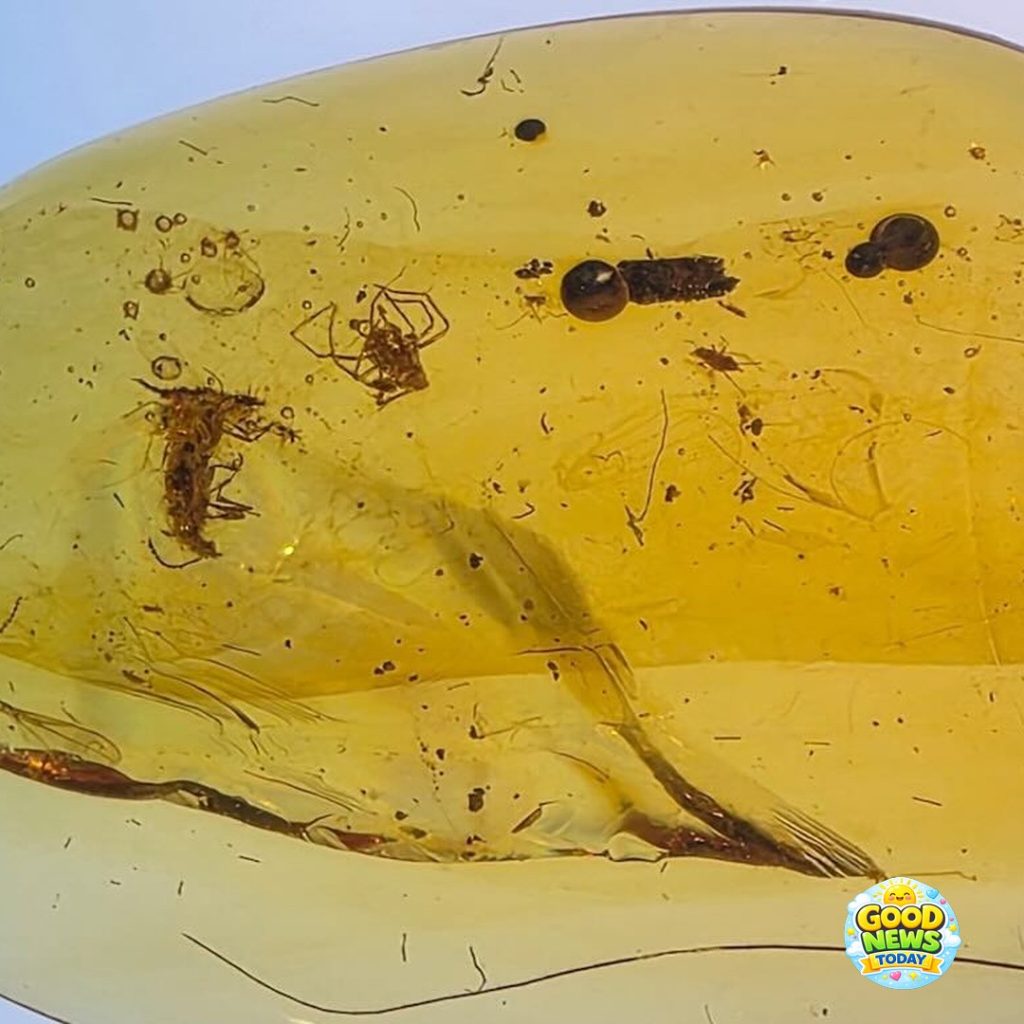
Insects are vital players in our ecosystems, yet their preservation as fossils is quite rare, making it challenging to study their roles within ancient habitats. However, fossilized tree resin, when transformed into amber, sometimes captures insects, preserving a moment from the distant past.
Among the most extraordinary finds are pieces of amber that encapsulate multiple insects living in close quarters, offering a unique glimpse into the ecosystems of ancient geological periods. A pressing question arises from these discoveries: Were these insects pollinators, parasites, predators, or merely caught in a serendipitous moment?
A recent study conducted by researchers in Spain delves into six pieces of amber containing fossilized ants that coexisted with dinosaurs during the Cretaceous period. These remarkable samples showcase a variety of organisms from different species—a phenomenon known as ‘syninclusion’—which provides invaluable insights into their interactions.
Dr. Jose de la Fuente, the lead author of the study from the Institute for Game and Wildlife Research in Ciudad Real, emphasized the significance of amber inclusions, stating, “They represent possible interactions between different organisms shaping the environment, providing a snapshot of life on Earth millions of years ago.”
Ants are particularly crucial to ecosystem dynamics. The earliest known ants, referred to as Stem ants, emerged during the Upper Cretaceous period, between 66 and 100 million years ago, and have no living descendants. In contrast, all modern ants evolved from a group known as Crown ants. The study’s amber samples included both types, as well as their unique relatives, the Hell ants.
Published in the journal Frontiers in Ecology and Evolution, the study examined four pieces of Cretaceous amber approximately 99 million years old, alongside one piece of Eocene amber from about 34 to 56 million years ago and another from the Oligocene period dating back 23 to 34 million years.
Using advanced microscopy, researchers discovered that three of the six amber samples contained ants in close proximity to mites. One intriguing piece featured a Crown ant alongside a wasp and two mites so near that they may have been hitching a ride. Another sample, known as Case 4, revealed a Stem ant and a mite located merely four millimeters apart (around 1/10 inch).
In a further sample, scientists identified three different species of ants cohabiting with a mite, termites, mosquitoes, and a winged insect. Another amber piece from Case 6 showcased a Stem ant that appeared to be feeding, accompanied by a possible parasitic wasp and a spider. Additional findings included a Stem ant near a spider, while another amber piece contained a Hell ant, a snail, a millipede, and various unidentified insects.
Dr. de la Fuente noted that the ant-mite interactions observed in Case 4 may indicate two potential ecological roles, providing a fascinating insight into the complex relationships that existed in these ancient environments.