
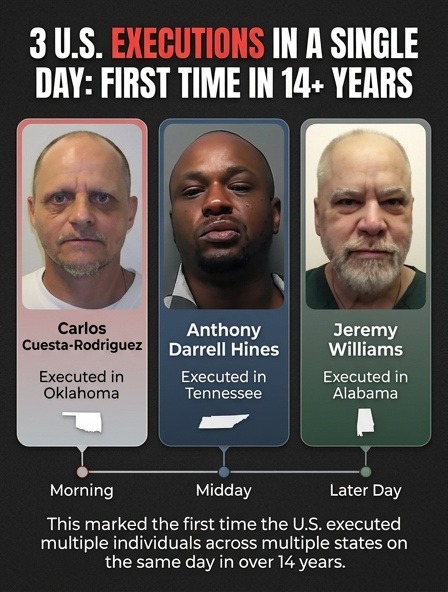
In what marks a rare and somber milestone in the American justice system, three executions took place across different states on the same day—an event not seen in over 16 years. The coordinated series of lethal injections highlights both the persistent use of capital punishment in the United States and the ongoing debates surrounding its moral and legal implications.
Early Thursday morning, Carlos Cuesta-Rodriguez was put to death in Oklahoma for the murder of his girlfriend, Olimpia Fisher. Cuesta-Rodriguez, sentenced to death for the brutal killing, was executed shortly after 6 a.m. local time. The state’s execution process, long criticized for its legal complexities and ethical controversies, proceeded after years of legal battles and appeals.
Just about half an hour later, in Tennessee, Anthony Darrell Hines faced his fate for the murder of a motel maid, Catherine Jean Jenkins. Hines’s case garnered considerable media attention, with authorities detailing the violent circumstances leading to Jenkins’s death. His execution underscores the ongoing use of capital punishment for violent crimes, despite widespread public debate about its efficacy and morality.
Later in the day, Alabama conducted the third execution, that of Jeremy Williams. Williams was executed for the rape and murder of 5-year-old Kamarie Holland, a case that sparked significant outrage and mourning among community members and advocacy groups. His case, like others, was heavily litigated, with supporters arguing for clemency and opponents condemning the death penalty as inhumane.
This unprecedented day is notable not just for its scale but also because it is the first time since 2010 that three executions have occurred on the same day in different states. The coordinated timing creates a sobering reflection on the federal and state-level persistence of lethal injections as a form of justice, amidst ongoing debates over their ethics and constitutionality.
Legal experts point out that scheduling multiple executions in a single day involves complex logistical challenges and legal procedures, including court approvals, inmate notification, and the coordination of prison staff. Critics argue that such scheduling can be viewed as a form of theatrical demonstration for proponents of capital punishment, while supporters view it as the effective administration of justice.
As the nation processes this rare occurrence, human rights advocates and opposition groups renew calls for abolition, citing concerns over wrongful convictions, racial disparities, and the inhumane nature of the death penalty. Meanwhile, supporters maintain that carried-out executions serve as a deterrent against violent crime and deliver deserved justice for victims and their families.
Regardless of perspective, the day’s events serve as a stark reminder of the enduring and deeply divisive debate about capital punishment in America—and the complex, often controversial process that governs its application.