
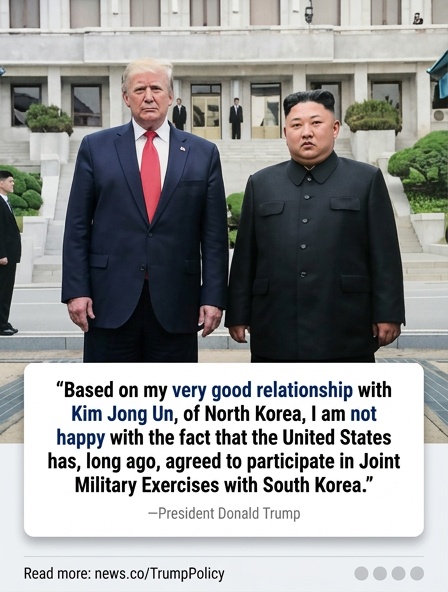
In a surprising and significant policy shift, President Donald Trump has ordered a major reduction in joint U.S.-South Korea military exercises, citing concerns over costs and the provocative signals these drills send to North Korea. The directive comes just one day before the annual Ulchi Freedom Shield exercises are set to commence, involving approximately 18,000 South Korean troops alongside around 28,500 American service members stationed in South Korea.
President Trump’s announcement has already sent ripples through the security community, raising questions about the future of U.S.-South Korea military cooperation amid escalating North Korean missile tests. Trump criticized the drills as “too costly” and claimed they give a “totally inappropriate and hostile” signal to North Korea’s leader, Kim Jong Un. The timing of the order has been viewed as particularly strategic, coinciding with a recent uptick in North Korea’s missile testing activity—two ballistic missile launches within six days this month have underscored the regime’s increasing military assertiveness.
Adding to the complexity of the situation, Trump also pointed out that South Korea recently declined to participate with the U.S. in efforts related to the “denuclearization of the Islamic Republic of Iran,” a move that reportedly disappointed U.S. officials. This comment signals growing concerns within Washington about South Korea’s geopolitical stance and its willingness to align on broader regional and global issues.
While critics worry that reducing military exercises could embolden North Korea and destabilize the fragile regional balance, Trump maintains that the move will promote diplomacy and reduce tensions. “We’re going to cut back a lot on the exercises, which are very expensive, and send a message of peace and stability instead,” he said in a recent statement. However, defense experts warn that this could be a gamble, as North Korea might interpret the reduced military presence as an opportunity to advance its missile and nuclear programs without increased American and South Korean pressure.
This development arrives amidst ongoing fears of North Korea’s missile ambitions, with Pyongyang demonstrating its military capabilities through repeated launches and warnings. The recent missile tests, combined with the diplomatic signals from Washington, suggest a shifting strategy that could impact regional security dynamics significantly.
As the world watches carefully, many analysts question whether this move signals a new phase in U.S.-South Korea relations or a temporary tactical measure. With tensions running high and North Korea’s missile tests showing no signs of slowing, the coming weeks will likely be critical in determining the future course of action for the alliance and the broader stability of the Korean Peninsula.
Where to Learn More
- Trump Orders Major Cut in U.S.-South Korea Drills as North Korea Ramps Up Missile Tests – Fox News
- U.S. Shrinks Military Exercises with South Korea Amid North Korea Tensions – The New York Times
- U.S. to Scale Down Military Drills in South Korea, Cites Cost and Hostility Concerns – Reuters
- North Korea Launches Two Missiles in Six Days as U.S. Reduces Military Exercises – CNN