
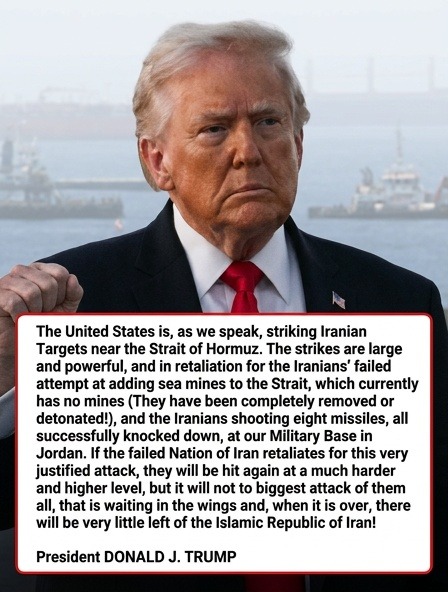
In a dramatic and fiery announcement, President Donald Trump has declared the United States has launched “large and powerful” military strikes against Iranian targets near the strategic Strait of Hormuz. The president warned Tehran that if Iran retaliates, the U.S. will respond even more forcefully, hinting at a potential “bigger attack” that could leave a profound impact on the Islamic Republic.
This development marks a significant escalation in U.S.-Iran tensions, with President Trump emphasizing the perceived need to act decisively against Iran’s recent provocations. He stated via social media, “If the failed Nation of Iran retaliates for this very justified attack, they will be hit again at a much harder and higher level, but it will not be the biggest attack of them all, that is waiting in the wings and, when it is over, there will be very little left of the Islamic Republic of Iran!”
While the exact targets of the strikes have not been publicly disclosed, reports suggest they targeted military facilities believed to be involved in nuclear proliferation activities and missile development in locations near the sensitive Strait of Hormuz, a vital conduit for global oil supplies. The U.S. military confirmed that the strikes are aimed at degrading Iran’s ability to threaten regional and international security.
The escalation comes amid ongoing fears of broader conflict in the region, which has seen a rise in tense encounters between U.S. naval forces and Iranian ships, as well as recent missile tests and drone activities by Iran. The Strait of Hormuz remains a critical chokepoint through which about 20% of the world’s oil passes daily, making any conflict or disruption potentially destabilizing for the global economy.
President Trump’s bold language and aggressive posture signal a shift toward a more confrontational approach. Diplomats and analysts are divided on the potential fallout, with some warning that such aggressive military actions could spiral into a larger regional or even global conflict. Others argue that strong U.S. action is necessary to counter Iran’s destabilizing behavior in the Middle East.
As global markets react nervously to the news, international leaders are urging caution and diplomatic restraint. Iran’s government has responded with fiery rhetoric, condemning the strikes as an act of aggression, and has vowed to retaliate “at the right time and place.” The situation remains highly volatile, with military experts closely monitoring developments.
Meanwhile, on social media, outrage and support are sharply divided. Supporters of President Trump praise his decisive action against Iran, while critics warn that escalating military confrontations could lead to a wider regional war with devastating consequences.
The world watches nervously as America prepares for what could be an extended period of heightened military activity in the Middle East, emphasizing the urgent need for diplomatic solutions amid rising tensions.