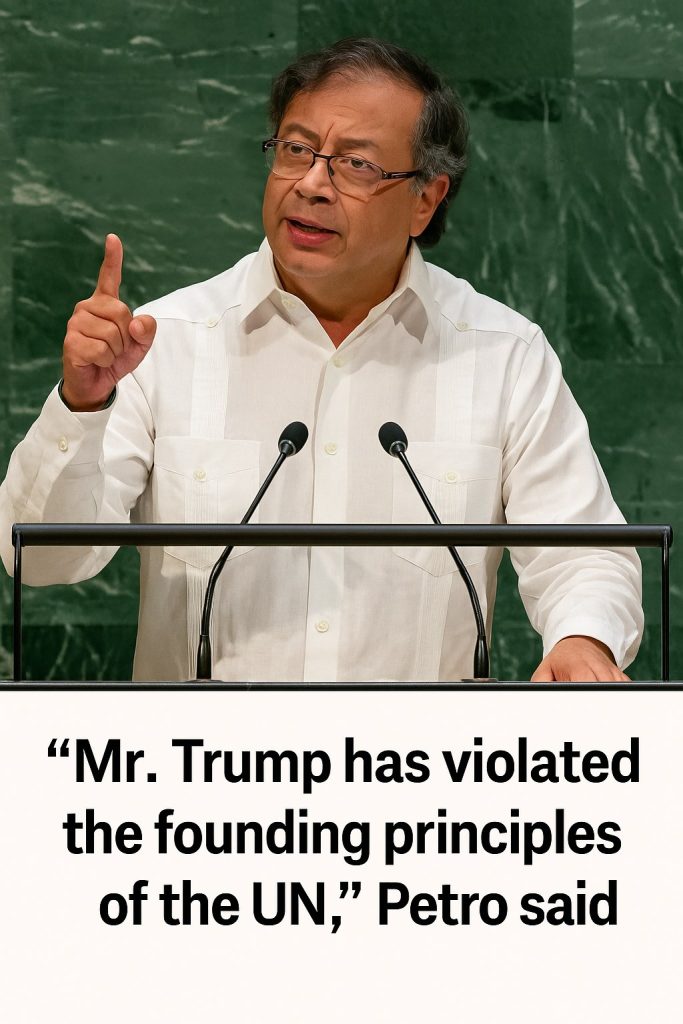
In a bold statement that has reverberated across social media and the diplomatic community, Colombian President Gustavo Petro accused former U.S. President Donald Trump of violating the foundational principles of the United Nations (UN). This assertion comes amid growing concerns over Trump’s past foreign policies and rhetoric that some view as contradictory to the UN’s mission of promoting peace and cooperation among nations.
During a recent interview, President Petro specifically pointed to Trump’s unilateral decisions, such as the withdrawal from the Paris Agreement and his approach towards international trade agreements. “Mr. Trump has violated the founding principles of the UN,” Petro stated, highlighting the potential ramifications of such actions on global collaboration and climate change initiatives.
Petro’s comments strike a chord in a time when the world is more interconnected yet politically fragmented than ever. The Colombian leader’s remarks are not just a critique of Trump; they reflect a broader concern shared by many world leaders regarding the current state of international relations. His statement has sparked a wave of discussion online, with social media users sharing their opinions on whether Trump’s policies indeed undermined the UN’s efforts or if they simply reflected American sovereignty over global mandates.
Critics of Trump have long argued that his presidency marked a departure from multilateralism, emphasizing “America First” policies that often sidelined international agreements. Petro’s remarks serve as a reminder of the potential isolationism that can arise when national interests overshadow collective responsibilities. By highlighting Trump’s actions as violations of UN principles, Petro indirectly raises questions about global leadership and accountability.
As the political landscape continues to shift, the conversation surrounding Trump’s impact on international cooperation grows ever more relevant. The diplomatic community is left to ponder: how will future U.S. administrations address these concerns, and can the international community navigate the lingering effects of Trump’s tenure?
In response to Petro’s comments, political analysts suggest that the conversation could influence future U.S.-Latin American relations. They argue that a return to multilateral agreements, especially in areas like trade and environmental policy, is crucial for restoring trust and cooperation among nations. As leaders like Petro advocate for a more collaborative approach, the emphasis on shared global challenges is more pertinent than ever.
The implications of Petro’s statement extend beyond just U.S. foreign policy; they raise critical questions about the future of the UN in an age where populism and nationalism are on the rise. As countries increasingly adopt inward-looking policies, the challenge for global organizations is to adapt and ensure that their founding principles are upheld.
As this discussion evolves, it remains to be seen how other leaders will respond. Will they rally behind Petro’s sentiments, or will they choose to support more nationalist agendas? The world is watching closely.