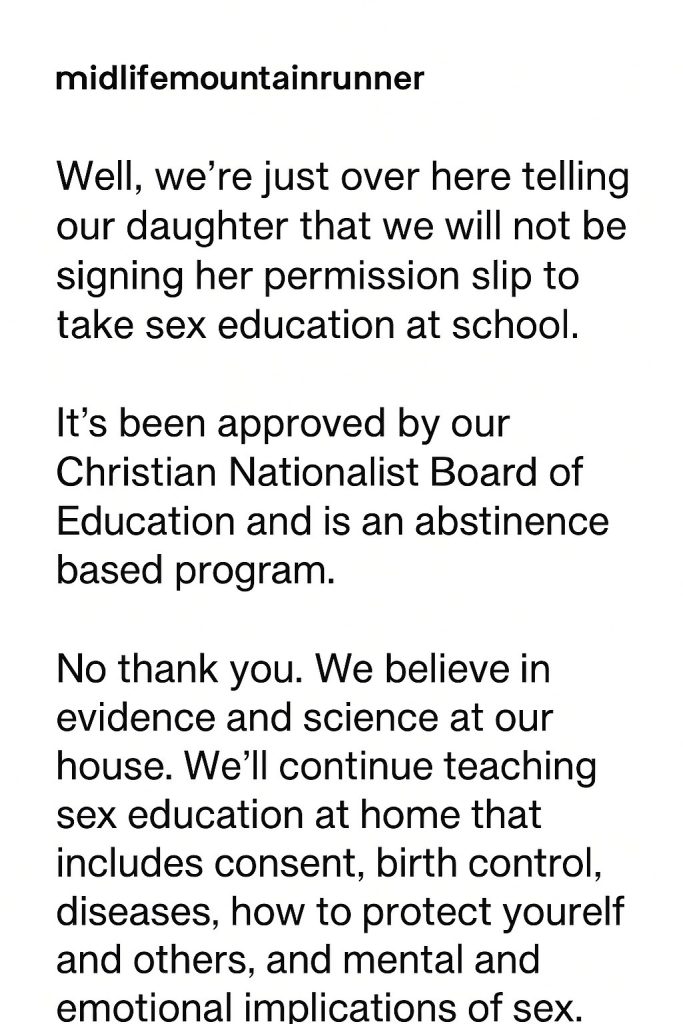
A recent social media post has ignited a widespread discussion after a parent publicly announced their decision to withhold permission for their child to attend a school sex education class. The post, which originated from the Instagram account midlifemountainrunner, shared a candid moment of telling their daughter they would not be signing the permission slip to participate in the course.
The controversy over sex education in schools is not new, but the post quickly went viral, reflecting the divide in public opinion about how and when children should be taught about sexuality. While some parents advocate for comprehensive, age-appropriate lessons that promote understanding, safety, and consent, others continue to voice concerns over content, age suitability, or prefer to address these topics at home according to their own values.
In the shared message, the parent conveyed a desire to take control over the timing and nature of the information their daughter receives about sex and relationships. This approach reignites common questions faced by parents everywhere: How much should schools be involved in sex education? What role does parental consent play in shaping a child’s learning? And what are the implications of opting out?
Sex education programs across many states and countries vary widely in their curriculum, ranging from abstinence-only to comprehensive programs that include discussions about anatomy, contraception, healthy relationships, and emotional wellbeing. Experts widely agree that effective sex education can promote safer choices among teens, reduce rates of unintended pregnancies and sexually transmitted infections (STIs), and encourage open communication between parents and children.
However, midlifemountainrunner’s post underscores the perspective of parents who feel they should have the ultimate say in how and when their child receives this education. It also highlights a growing trend where some parents are opting their children out by refusing consent through permission slips, a practice permitted in many school districts but with differing policies and procedures.
The larger conversation touches on the balance between respecting family autonomy and ensuring all young people receive essential knowledge to navigate the complexities of growing up safely. Advocates argue that denying access to quality sex education may leave children vulnerable to misinformation and risk, while opponents often emphasize parental rights and values.
As this discussion continues to unfold online and in local communities, schools, educators, and policymakers face the challenge of addressing parents’ concerns while providing scientifically accurate, inclusive, and developmentally appropriate education.
What comes next? It remains critical for schools to maintain open communication channels with families and create environments where questions and fears can be addressed openly. Meanwhile, parents like those behind the viral post encourage ongoing dialogue within families about important life topics, even if outside the classroom.
This episode serves as a reminder that sex education is not just a school subject but a community conversation that requires sensitivity, respect, and collaboration to meet the needs of today’s youth.
Where to Learn More
- Sex Education – CDC – Centers for Disease Control and Prevention
- Sexuality Education and Families – GLSEN
- Sex Education Basics – Planned Parenthood
- What to Do if Your School Teaches Bad Sex Ed – Common Sense Media
- Comprehensive Sexuality Education – UNICEF